The Only Metric That Matters: Choosing What Your Product Is Designed to Achieve
 Joris Beerda19 September 2017
Updated 10 November 2026
Every number on a company dashboard records something people chose to do. Revenue records purchases and renewals. Retention records the decision to come back. A marketplace’s transaction volume records thousands of moments in which a buyer trusted a stranger enough to pay.
Because those choices are voluntary, the metric a company puts first decides which behavior its product is built to motivate. It also shapes how people feel while they are doing it. Choosing that metric is therefore the first design decision a leadership team makes, usually long before anyone sketches a screen.
The argument of this article runs in three steps. A business ranks the results it needs. Those results depend on specific Desired Actions taken by specific people. People take those actions, and keep taking them where the business needs repetition, when the action leads them to a Win-State inside an experience that motivates them. A weak link anywhere in that sequence shows up later as a metric that will not move, or as one that moves while the business gets no healthier.
A top metric shapes the experience around it
Zynga’s social games are a familiar illustration. A game steered mainly by daily active users and monetization rewards its designers for anything that brings players back today and gets them to pay today. The fastest tools for that are timers, expiring rewards, crops that wither if they are not harvested, and prompts to pay to skip a wait.
In Octalysis terms these are Black Hat techniques. The Octalysis Framework describes eight Core Drives of human motivation and distinguishes them by how they feel to the person experiencing them. Black Hat drives such as Scarcity & Impatience and Loss & Avoidance create urgency, and they are effective at producing immediate action. Used with care they have a legitimate place in a design. Relied on alone, they leave people feeling that the product controls them. White Hat drives such as Development & Accomplishment and Empowerment of Creativity & Feedback work differently. They make people feel capable and in control, which is what sustains long involvement, but they create little urgency.
A player who returns because something will be lost otherwise counts as active, and the dashboard looks healthy. The cost appears later in the journey. Octalysis divides an experience into four phases: Discovery, Onboarding, Scaffolding and Endgame. Pressure can carry people through Onboarding. It gives them little to stay for in Scaffolding, where continuing play has to become rewarding in itself, and few of them reach the Endgame, where a game’s most committed players are found.
The example shows how faithfully a design follows its metric. Two short-term numbers at the top of the list produce an experience built for short-term response, and the players who might have stayed bear the cost.
The obvious number is often a means to something else
eBay earns fees on transactions, so transactions look like the natural number to put first. A transaction between strangers, however, depends on trust, and on eBay trust is built largely through ratings. A buyer who sees a seller’s record of good feedback is willing to pay. A seller who knows the next rating depends on this order has reason to describe the item accurately and ship it well. Designing for ratings and seller quality is a way of designing for transactions, through the condition that makes them possible.
Yu-kai Chou, the creator of the Octalysis Framework, describes a related discussion from his work with eBay’s quality team. The team wanted to reduce the frustration buyers felt with unprofessional sellers, and its first suggestion for a top metric was time on page on the seller dashboard. Yu-kai pointed out that putting a card game on the dashboard would raise time on page considerably and do nothing for buyers. The team settled on reducing bad buying experiences, measured by complaints. Time on page stayed on the list as a means to that end.
His question in that discussion is a useful one for any ranking. If your top metric were doing extremely well while the others stayed mediocre, would the business be succeeding? When the answer is no, the top metric is a means, and something below it deserves the place.
Metrics move through Desired Actions
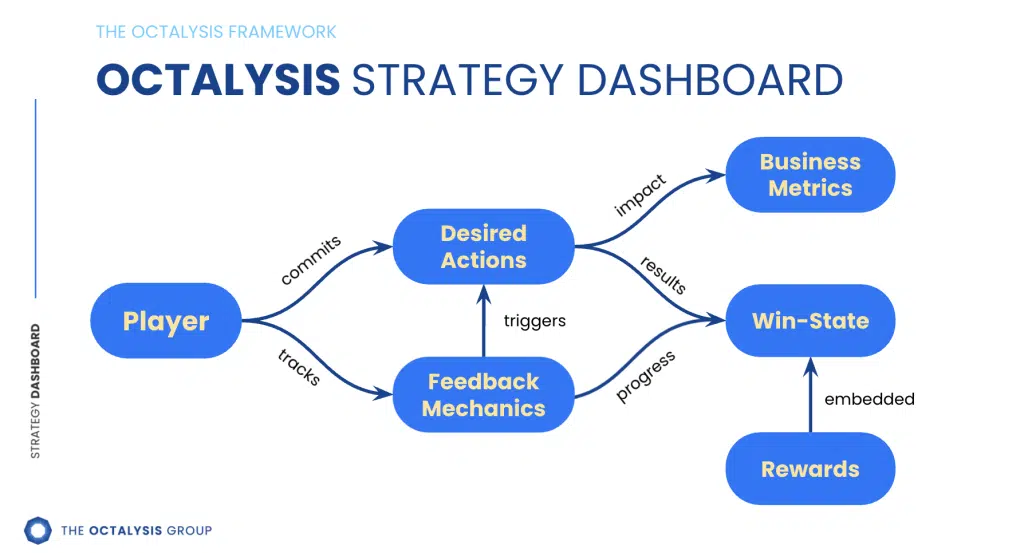
No one improves a metric directly. Users improve it by doing things, and in Octalysis design (our approach to gamification) those things are called Desired Actions: searching, completing a profile, leaving a review, finishing a lesson, entering payment details, renewing.
The relationship is rarely one action to one metric. Recurring revenue depends on a subscriber getting enough value during the month, on a payment going through, and on a decision to stay when the renewal notice arrives. A single action can also serve several metrics. A buyer’s review supports trust, which helps both the conversion of the next buyer and the quality of the seller’s next listing. Mapping these dependencies shows where the business outcome is actually decided.
It also forces precision about the metric itself. “Active user” means little until someone specifies what an active user did. Opening an app for five seconds is a much lower bar than completing a lesson, answering a buyer’s message or logging a client visit, and each definition asks for a different product. Yu-kai’s masterclass example is a video platform. Videos watched can rise while people leave after two seconds. Videos completed is closer to the appreciation that predicts they will watch again.
The ranking matters most at individual moments in the journey, because one screen can usually favor only one main Desired Action. Yu-kai’s example in his article on the Strategy Dashboard is a home page. If new registrations rank first, the sign-up form takes the space and returning users get a small login link. If daily returns rank first, the arrangement reverses. A team without a ranking tends to give both equal weight, and a visitor faced with competing requests often chooses neither.
What the user gains: the Win-State
A Desired Action costs the user effort and attention, and they can abandon it at any step. They continue when the action takes them somewhere worth reaching. That place is the Win-State: the moment the person registers that they have gained something, whether practical, emotional or intellectual.
Win-States come in different sizes. A room booked for the right dates at a price the traveler feels good about is a complete win in a single session, and so is a checkout that ends with confidence that the order is correct. Other wins are steps on a longer path. A seller’s first positive rating, a learner’s first conversation understood and a sales rep’s client record that makes the next visit easier all fit that description. Some businesses need an action repeated daily for years. Others need it done once, done well, and remembered favorably. The top metric tells you which case you are in.
Completing an action does not automatically feel like winning, and a badge or a points total attached afterward does not change that. The surrounding experience has to make the gain felt. This is where the Core Drives do their work. A team asks which motivations are present as the person approaches the action and which are pulling them elsewhere. It also asks what the person sees and feels immediately after acting. Progress they can perceive speaks to Development & Accomplishment. A choice whose consequences they can observe speaks to Empowerment of Creativity & Feedback. A deadline speaks to Scarcity & Impatience. The right mix depends on the people involved, because different groups of users are motivated differently, and on whether the business needs one decisive action or a lasting relationship.
When the three elements line up, the company’s success and the user’s win are the same event seen from two sides. The buyer gets a purchase they trust and the marketplace gets its transaction. When they do not line up, a company can have an experience people enjoy that never reaches the result it needs. Or it can have a metric that climbs while its users grow tired of the product.
Priorities follow strategy, and strategy changes
No ranking is correct for every company. A venture-backed startup proving demand may reasonably put new active users first. An established business defending its customers may put retention or lifetime value first. A subscription business with high fixed costs may rank recurring revenue above everything else, since one-off revenue can look impressive in one quarter and tell you little about the next.
A workable list is short, quantifiable and ordered, with the ends above the means. It should also be examined for behavior it might produce by accident. A target for new users can fill a product with people who leave within a month, and aggressive monetization can shorten the time customers stay. The list should be revisited whenever the strategy shifts, because a ranking that suited a launch can misdirect a mature product.
Many of the companies we work with revise their priorities at this stage. Some find they have more equal priorities than a design can serve. Others find that the objective at the top was a means to something they had not yet named. Making that discovery before design begins costs far less than making it after launch.
The metric that matters
The only metric that matters is the one your business depends on at this point in its strategy, defined precisely enough that you can name the actions that move it and the win each action gives the person taking it. With those three things established, a team can judge every proposed feature by what it does for the user and for the business.
Ranking Business Metrics is the first element of the Strategy Dashboard, which goes on to define the users, their Desired Actions, and the feedback and rewards that make each Win-State felt. If you would like to work through that with us for your own product, contact us.