Gamification in Marketing: How to Use Science to Get True Customer Loyalty
 Joris Beerda23 February 2024
Updated 19 November 2026
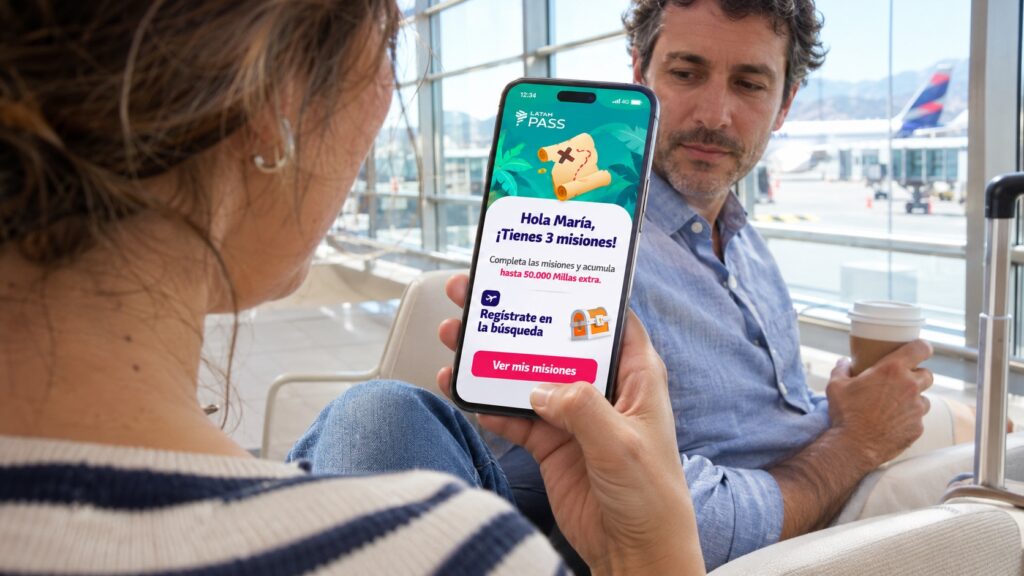
When LATAM Airlines asked The Octalysis Group for a marketing program redesign of LATAM Pass, its loyalty program, they set the bar at their own best work: use gamification in marketing to beat the conversion of their strongest traditional campaigns by 20%. Mile accumulation ended 123% above the historical average and credit card acquisitions increased by 153%. LATAM was so surprised that they quickly had to add a lot more marketing budget to keep up with the response.
The Octalysis Group didn’t increase reward size or add more points for the same actions. What Octalysis did is create a truly engaging and immersive journey for users to have meaningful social collaboration and have a path to success other than just flying more to collect air miles.
Most marketing campaigns and loyalty programs are not user journeys that users want to come back to over time. They are linear and focused on collecting extrinsic rewards rather than optimizing for the intrinsic, more long-term motivation that people have to engage in experiences.
This is what The Octalysis Group has perfected over the last 13 years and implemented with marketing and loyalty programs around the world. The Octalysis Framework has been adopted by the academic community: there are currently more than 5,000 academic references to the Octalysis Framework and the work of The Octalysis Group. For a marketing leadership team, that research base limits the risk of innovation.
What is gamification in marketing?
Gamification in marketing is the design of campaigns, buying journeys and loyalty programs around what motivates customers to act. It applies what successful games know about human motivation. Nobody has to play a game, so the games that hold people for years are built around what people want to do. Marketing works under the same condition: no customer has to open your email, join your program or come back after a first purchase.
We start from the business metric, define the Desired Actions customers have to take to move it, and design an experience that makes those actions engaging for the customers you serve. Points, badges and prize draws are a small part of that work. Our article on what gamification is and what it is not gives the full definition, and why marketing and branding need to start with human motivation applies the same thinking to brand campaigns.
Why a standard campaign stops working when it ends
Most marketing campaigns follow one pattern: take this action before the deadline and receive this reward. In Octalysis we call this an Earned Lunch, because action and prize are known in advance. It suits customers who already planned to buy. For everyone else it has three limits.
The first limit is the size of the pull. Yu-kai Chou, the creator of the Octalysis Framework, puts it this way in Actionable Gamification: “If we know we will receive a reward, our excitement only reflects the emotional value of the reward itself.” A bonus miles offer is exactly as exciting as those miles are to the member reading it.
The second limit appears when the reward stops. In the best known study of the overjustification effect, Lepper, Greene and Nisbett (1973) found that children rewarded for drawing, which they already enjoyed, lost interest once the reward was gone. The same pattern shows up in companies: once the extrinsic reward stops, motivation often falls below the level it had before the reward was introduced. The risk is largest where customers already liked something about your brand.
The third limit is competition. Points, status, discounts and cashback sit on the Left Brain side of the octagon, the Core Drives about obtaining something, and a competitor can always offer more. Members who stay for the deal leave for a better one, which is why we treat churn as a design problem and not a campaign problem. Yu-kai calls this the Mercenary Program Trap and proposes one test: would your members leave the moment a competitor offered 10% better rewards? A customer who buys a product ten times would probably pay for the eleventh as well, so a free eleventh purchase rewards loyalty that already existed.
Why points on a high-effort action rarely work
The usual response is a gamified marketing campaign: add points, a badge, a leaderboard or a spin wheel. Points and badges have a real place: they show progress and carry newcomers through the first sessions. On their own they do not build habits. They work less well when the action is demanding and the reward is small.
The Father’s Day Clock Giveaway by Tires Plus shows the problem. Customers wrote essays about who qualified as the best dad, and votes decided who took home a Michelin Man clock. The techniques came from a successful Dove campaign, but the essay was a Desired Action that took a lot of effort for a simple extrinsic prize, and Loss & Avoidance kept many people from taking part. We call this an Anti Core Drive, a motivation that works against the action. More points do not remove it; the design has to address the reason people hold back.
Copying a successful app is a related mistake. Strava’s segments work because people already love cycling and running, provided competition is not forced on everyone. Collecting airline points has no such starting motivation, so a streak only adds more of the extrinsic motivation the program already runs on.
Even a popular campaign can miss the action the business needs. Our Strategy Dashboard article describes companies whose users love their social media campaign but rarely take the next step of signing up on the website. What we call the Golden Triforce aligns the two: the user’s Win-State comes from the Desired Action, and the Desired Action moves the business metric.
How unpredictability changes the response to the same reward
The way a reward arrives changes what it does. In B.F. Skinner’s experiments, an animal fed every time it pressed a lever stopped once it was full, while one fed unpredictably kept pressing whether it was hungry or not. For marketing, the stronger lesson of the Skinner Box concerns unpredictable results, Core Drive 7 in Octalysis, which drive behavior far more than a fixed reward does.
Banks have applied this. The Chase Picks Up The Tab program, described in Actionable Gamification (2015), is one example. Every debit card swipe carried a very small chance of a text saying Chase had picked up the tab and $5 would be credited back. Customers swiped more to try to win again, and many told their friends. We call this an Easter Egg.
La Quinta’s Play & Stay app applied the principle to hotel loyalty. The Octalysis Group partnered with La Quinta on the app, which LuckyDiem built. Members spent tokens, which recharged over time, on a spin for points, collectibles and rare grand prizes such as 10 free nights, and trivia or referring a friend earned boosters that doubled scores. The La Quinta case study reports a 712% sales uplift against the control group, a 530% viral coefficient, 34% of users returning daily, 206% more bookings per user and $157 (132%) more revenue per user.
The numbers show the gap between campaign and experience. The launch email went to 83,600 people and 2.4% signed up, a fairly average result for email. With no further promotion, those 2,000 users brought in 10,700 referral signups within three months. The referrals came from what members found after they signed up. Copying the spin mechanic alone would not reproduce this.
Who receives a reward matters too. The Octalysis Framework maps motivation to eight Core Drives, and members differ in which ones move them, so we work out the dominant player types from each client’s own customers and give each a path.
Gamification in marketing in practice: what we built for LATAM Pass
LATAM’s campaign started from its business metrics: mile accumulation, credit card acquisitions, engagement with redemption and email performance. Several of the Desired Actions behind them had nothing to do with booking a flight, such as applying for the credit card, answering surveys and updating personal data. We translated LATAM’s demographic and psychographic data into a motivational profile for each audience type.
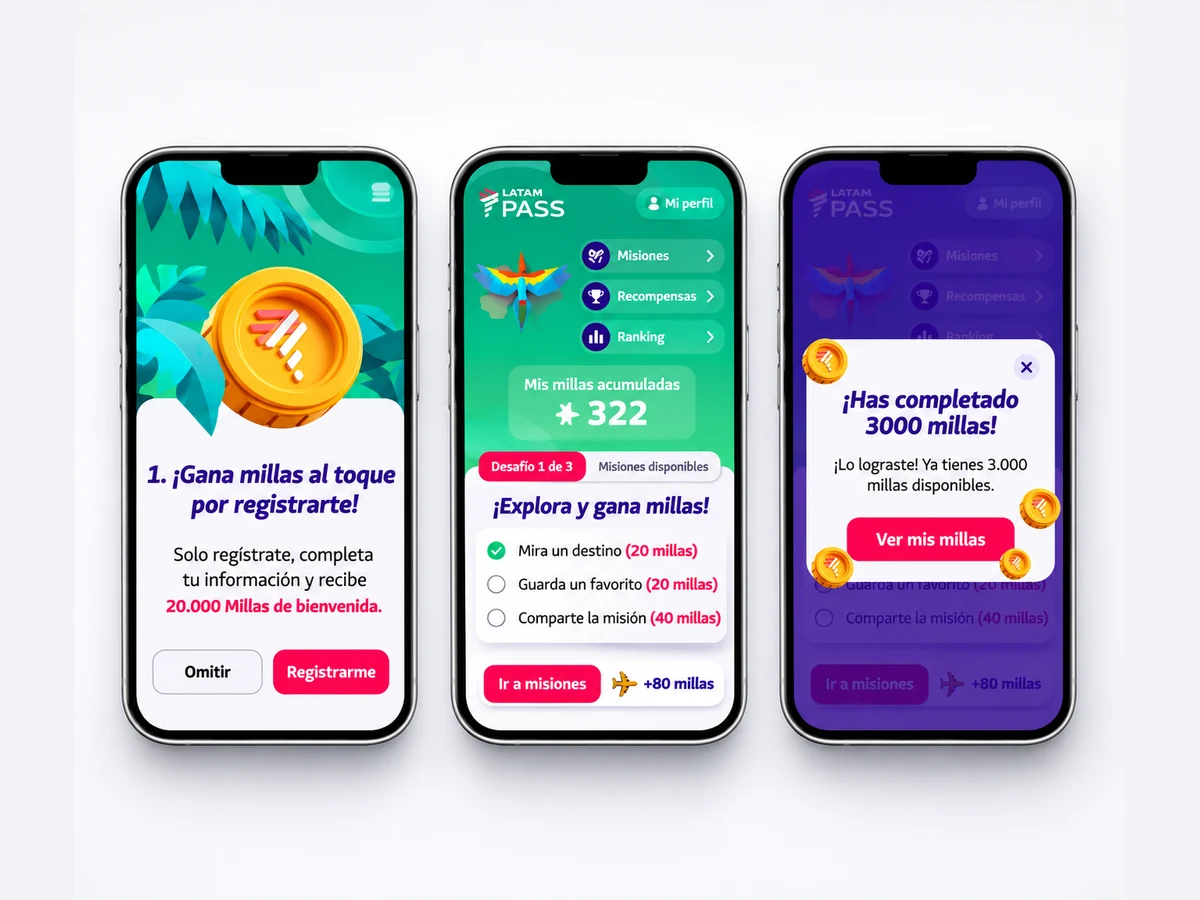
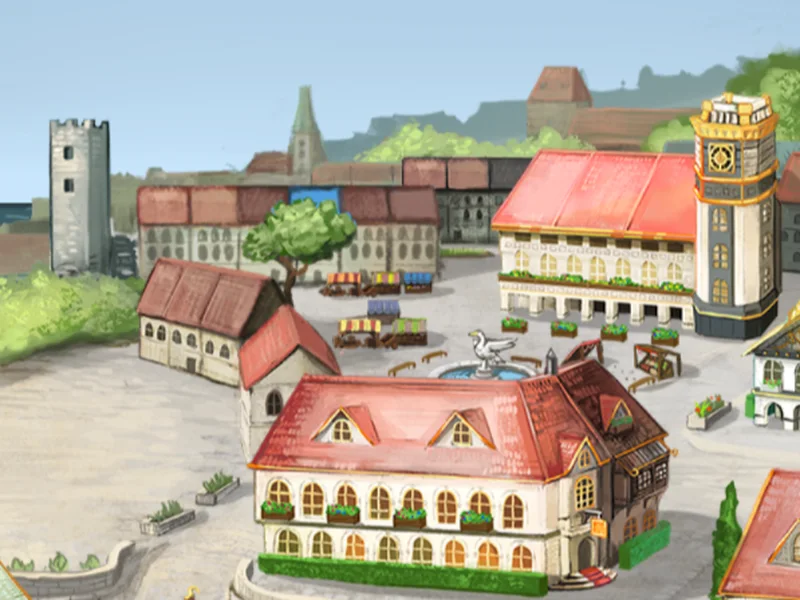
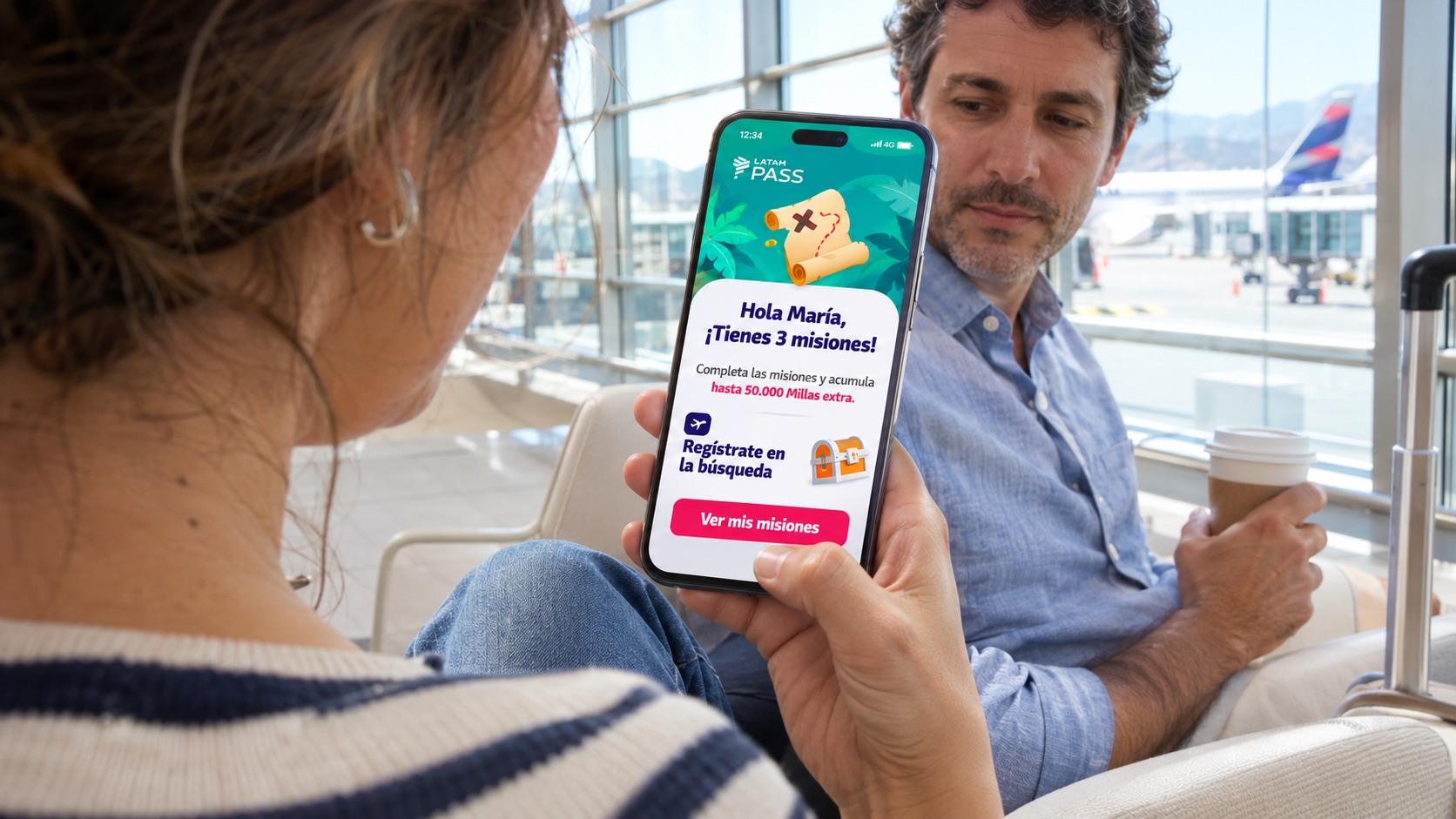
The design replaced standard mileage banners with a treasure hunt through the Latin American jungle. Members explored a map to find hidden treasures with varying rewards, which is Core Drive 7: Unpredictability & Curiosity. A countdown on hidden coins added Scarcity & Impatience, and members could see what other members were doing. Miles stayed central because members already valued them. Educational sections showed parts of the program members had never used, and mission sections gave them actions to take.
The campaign drew more than 160,000 unique visits. Mile accumulation rose 123% compared to historical averages, credit card acquisitions rose 153% and engagement with redemption rose 1,407%. It was built to show results within 30 days among members who were already active. The LATAM case study covers the design, and our article on activating loyalty members who rarely buy covers the inactive majority.
When urgency fits and when it burns people out
Curiosity and scarcity belong to the Black Hat Core Drives, together with Loss & Avoidance. Black Hat does not mean unethical. It describes motivation that creates urgency and can leave people feeling less in control. The White Hat drives (Epic Meaning & Calling, Development & Accomplishment, and Empowerment of Creativity & Feedback) make people feel capable and carry long-term engagement, but create no urgency. What people resent is Black Hat techniques used to make them buy things they do not need.
Booking.com, a client of The Octalysis Group that we advised in depth on its conversion metrics, shows where strong urgency fits. The metric is the look-to-book ratio, the share of searches that end in a reservation. Leisure travelers book a few trips a year, and a message that only one room is left changes the cost of waiting for someone who has already chosen, provided the scarcity is real. For a traveler still comparing twenty hotels the same message does much less, and a results page where every listing carries a warning reads as pressure. The same cues in an app people open several times a week add up to steady pressure. The Booking.com case study explains the difference.
For campaigns, our approach to transitions is to start with White Hat in marketing and onboarding, use Black Hat at the point of conversion, and reaffirm the decision with White Hat within seconds. Under its original One for One model, retired around 2019, TOMS did this by showing buyers the difference their purchase made for a child who needed shoes.
Loss & Avoidance needs one more rule. Telling members their miles or status are at risk creates urgency, but taking everything away makes them feel out of control, and many who finally leave a Black Hat system feel relief. Octalysis separates the Ultimate Loss a system can threaten from the Executable Loss it actually applies, and we keep the second small. We use the threat and always keep a clear way back. In our P&G sales program, a rep who had a weak period could recover by helping colleagues or giving training, actions that also helped the business.
Discovery and Onboarding: where the campaign hands over to the product
Octalysis divides an experience into four Experience Phases: Discovery, Onboarding, Scaffolding and Endgame. Where many frameworks start at sign up, we start earlier. As Yu-kai writes, “the user experience of a service does not start when people sign up to the service, but when they first hear about it.” Marketing usually owns Discovery, and the gap shows in Onboarding. The campaign promised a great experience, and the first thing a new customer meets is a username, a password, an email to confirm and a profile form. That sequence has no Win-State, and people feel a little betrayed.
Onboarding should lead to the First Major Win-State, the moment a user first feels the experience is worth it. Our Strategy Dashboard article puts the cost of delay plainly: “every second before a user hits the First Major Win-State, you are seeing dropout.”
Our 2019 launch of BONEO, the loyalty program we designed for Porsche and the Volkswagen Group, connected the two phases. The website contrasted fun in the car with boredom in traffic, and limited places in the Austrian pilot added Scarcity & Impatience. After signing up, members received a secret code shaped like a number plate. Entering it earned Award Points at once, and within seconds their first Carvatar, a digital twin of their car, rolled in for a virtual test drive. Our article on the BONEO launch describes each step.
Scaffolding and Endgame: keeping members active between purchases
Scaffolding is the regular journey of repeated actions, and most designs offer the same thing throughout: more points, another tier. In most loyalty programs we look at, up to 95% of members are inactive, which is why most loyalty programs are not really loyalty programs. In an airline program the main way to take part is to fly, yet those members could buy through partner stores, help newcomers, write guides or become the recognized expert on one airport.
As members gain experience, we add more intrinsic design, such as different strategies, social collaboration, joyful surprises and Epic Meaning & Calling, while points and miles stay as feedback on progress.
BONEO shows this works even for one of the least frequent purchases people make. Lootboxes dropped irregularly after drives, Carvatar upgrades let members see more of the map, and teams formed by driving style competed in a monthly Occupy! Challenge for territory. In pilot phases the app reached 90% daily active users, and the Porsche case study reports an average of 5.4 minutes a day in the app.
Endgame is the phase companies most often ignore, and for marketing it matters most. Most marketing program design is linear or consists of one-off campaigns, so nothing in it evolves as a customer gains experience. A user journey that evolves over time builds a community, and the loyalty of that community becomes the engine of growth for your marketing program.
In the Endgame we create motivational design that gives your internal and external brand ambassadors an engaging path to come back to. They can play a role in the onboarding of new users. They can become mavens, the members other people follow and look up to. As external brand ambassadors they also help you grow your user base.
Most programs hold veterans only through the fear of losing a tier, which a competitor’s status match removes with one email. A role such as mentor or maven does not transfer.
How to start with gamification in marketing
Every gamification in marketing project begins with the business metrics, quantified and in order of importance. From there we define the Desired Actions that move those metrics and the dominant player types among the customers. We record all of it in the Strategy Dashboard, which has five elements: Business Metrics, Users, Desired Actions, Feedback Mechanics and Incentives. Results are measured against the same metrics.
For a serious product or an older audience, the result often looks nothing like a game, as with the LinkedIn profile progress bar. Our gamification consulting services and loyalty program design pages describe how we work.
If your campaigns or loyalty program lose their effect after launch, contact us and tell us which action you need your customers to take.