













Education And Technology
Gamified Learning Platform
Gamified learning platform with clear learning journeys, deepening learning outcomes and reducing reliance on first-line support functions.
90%+Learners actively progressing
Framework
The Octalysis Group applies the world’s leading gamification and behavioral design framework to grow activation, retention, and revenue across digital products, learning, and workplaces.
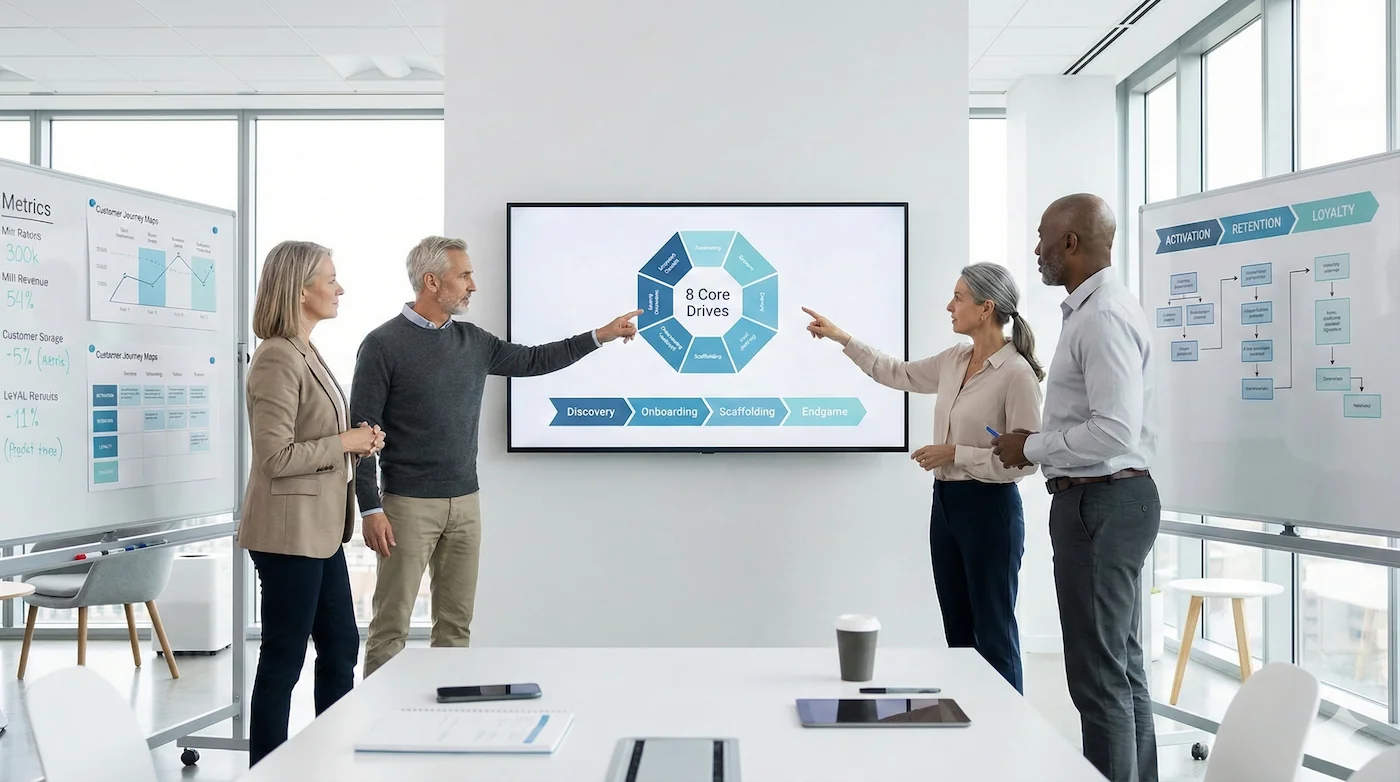
Octalysis is Yu‑kai Chou’s 8 Core Drives framework and the only science-backed behavioral design and gamification framework in the world, supported by over 3,700 academic citations. The Octalysis Group is the consulting firm that puts it to work, with over 175 clients worldwide.
Octalysis brings behavioral science and gameful design together in one testable design framework.
In this TEDx talk, Yu‑kai Chou introduces the 8 Core Drives of the Octalysis Framework and shows how gamification can change real‑world behavior.
Most products fail because they are “Function-Focused”: built to complete tasks. The Octalysis Framework allows us to build “Human-Focused” products, optimized for the feelings, insecurities, and motivations of the people using them.
With over 3,700 academic citations, it is the world’s most cited methodology for analyzing the 8 Core Drives of human motivation. We do not use these drives in isolation. We design combinations of them to create a balanced experience that drives specific business KPIs like Daily Active Users, Retention, Lifetime Value (LTV), and Referrals and many more.
Octalysis has led to over $5 Billion in new value for our clients. Along the way we have improved the user journeys of more than 1.5 Billion users.
The 8 Core Drives of Human Motivation
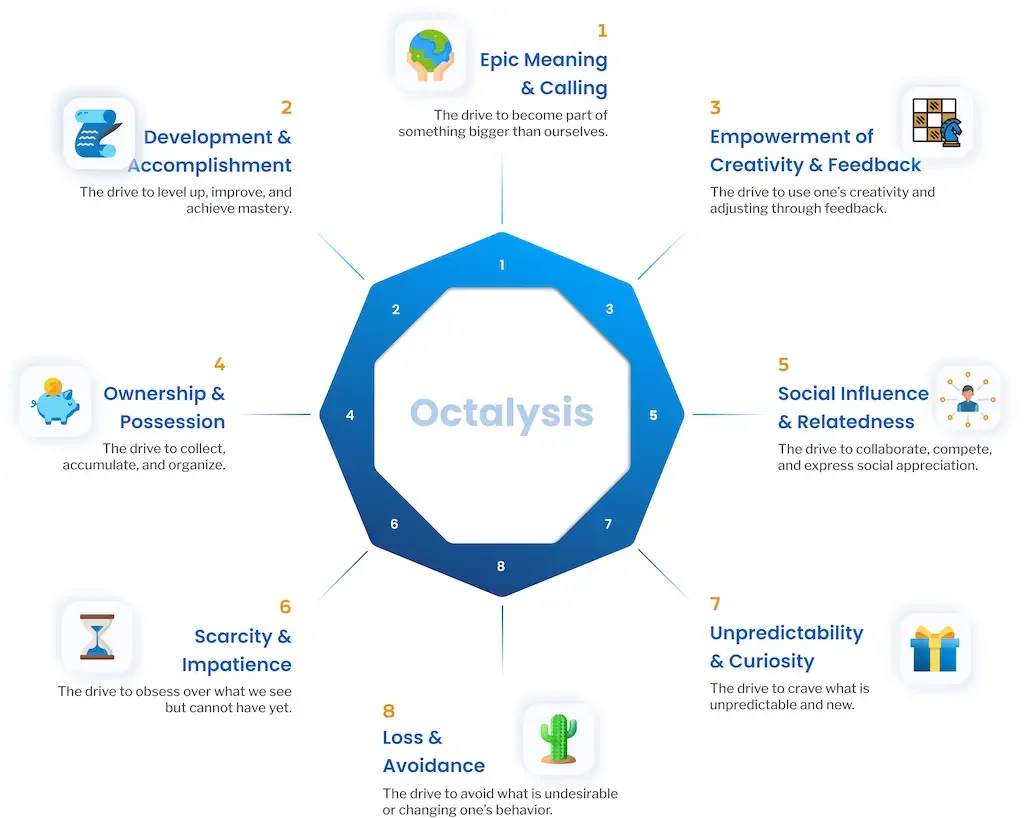
People take action when specific motivations are triggered. The Octalysis Framework organizes these motivations into 8 Core Drives that can be deliberately designed into your product, service, or the workplace.
Its foundations include Self-Determination Theory and BJ Fogg’s Behavioral Model.
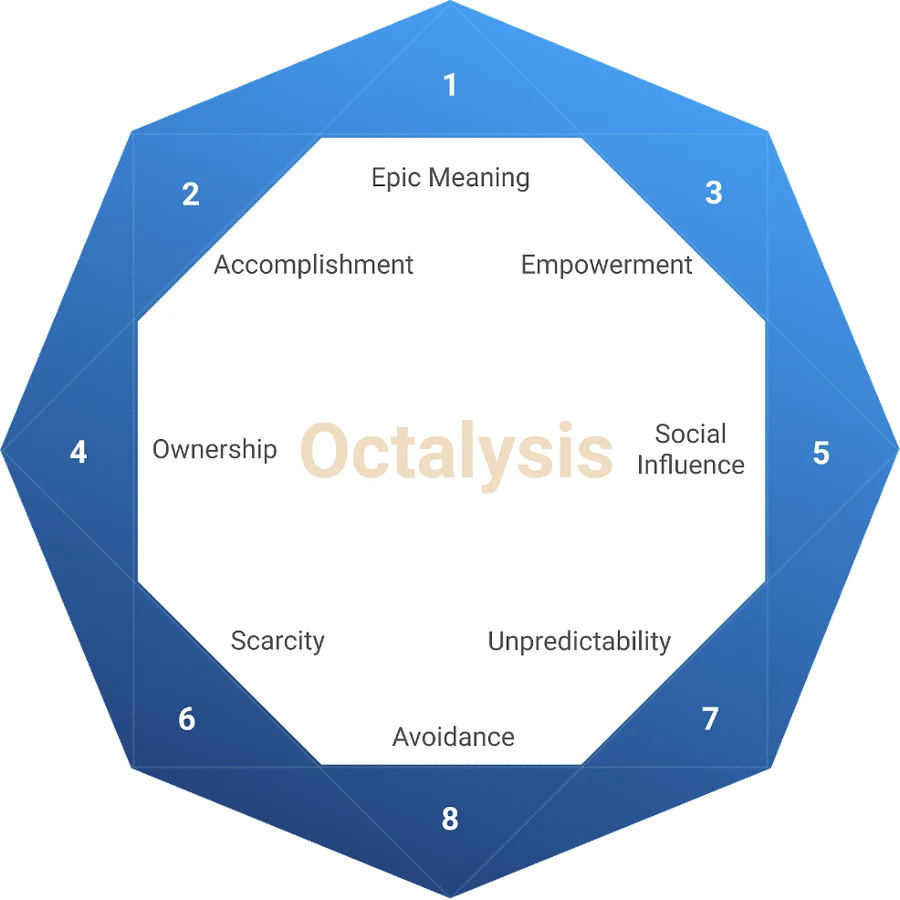
1Core Drive 1
The drive to feel part of a mission bigger than ourselves.
Business Impact. Gives customers and employees a clear sense of purpose, turning everyday actions into contributions to a larger mission. This grows brand loyalty, sparks organic word‑of‑mouth, and reduces acquisition and retention costs because people stay and invite others for the cause itself.
Use Case. The Octalysis Group designed a search experience for Ocean Hero where every few searches visibly fund the recovery of ocean‑bound plastic. Users see their impact in real time. The search product became a purpose‑driven movement, building a loyal user base and driving sustained usage despite heavy competition.
120 million+plastic bottles recycled from the Ocean

2Core Drive 2
The drive to make progress, build skills, and overcome challenges.
Business Impact. Clear goals, progress, and meaningful milestones turn routine work into visible achievement. This lifts performance, improves motivation, and makes it easier to sustain high‑value behaviors such as selling, reporting, and learning.
Use Case. For a global Procter & Gamble distributor, The Octalysis Group turned daily sales activities into a mission‑based progression system with levels, challenges, and rewards. Our gamified ecosystem drove a 28.6% revenue increase, 60% improvement on key KPIs, 300% more social interaction, and 99.5% voluntary adoption.
+28.6%Increase in sales revenue
3Core Drive 3
The drive to experiment, express creativity, and see meaningful feedback.
Business Impact. Letting users experiment with choices and see immediate feedback creates deep engagement and product stickiness. People return because they can try new strategies, personalize their journey, and feel in control.
Use Case. In Porsche’s “BONEO” loyalty ecosystem, users explore different mobility routes, open up new experiences, and receive instant feedback on their actions inside the app. The empowered creativity helped turn a functional car utility into a daily‑use lifestyle companion, achieving 90% DAU (daily active users) and 300% increase touchpoint interaction.
90%Daily active users
4Core Drive 4
The drive to own, control, and improve things we feel are “ours.”
Business Impact. When users feel they own their progress, data, or assets, they protect and grow them. This increases retention, upsell potential, and adherence in contexts ranging from finance to health and learning.
Use Case. For Pfizer’s chronic‑illness support app, The Octalysis Group designed a “health companion” where patients build and maintain a personal adherence track record, habits, and rewards over time. Treating health progress as something to own contributed to roughly 30% fewer drop‑outs and around 300% more daily engagement with treatment routines.
+30%Decrease in patient dropout rates across disease
5Core Drive 5
The drive to connect, compete, collaborate, and gain recognition.
Business Impact. Social proof, collaboration, and friendly competition tap into our desire to belong and be recognized. This drives higher participation, referrals, and customer or employee loyalty than incentives alone.
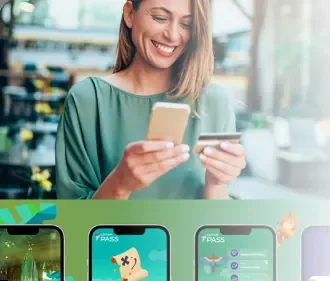
Use Case. For LATAM Airlines, The Octalysis Group redesigned the LATAM Pass loyalty experience around team play, social norms, and friendly competition. The “Treasure of Dreams” campaign achieved mileage accumulation up 123%, credit‑card acquisition up 153%, and a 1,407% increase in alternative mileage redemption, with over 160,000 unique visits and 8 million interactions.
+153%Increase in credit card acquisitions
6Core Drive 6
The drive to want what is rare, exclusive, or time‑limited.
Business Impact. Ethical scarcity and time‑bound opportunities shorten the gap between “I’m interested” and “I’ve decided.” Used well, this can significantly lift conversion without harming trust.
Use Case. Working with Booking.com, The Octalysis Group helped shape urgency and scarcity triggers (limited rooms, time‑bound deals, and real‑time demand signals) into the booking journey. These behavioral‑science tactics contributed to an 80% increase in gross profit after the key rollout period and set a new conversion benchmark for online travel agencies.
+80%Increase in gross profit
7Core Drive 7
The drive to keep going because you do not know what will happen next.
Business Impact. Smart surprises, evolving challenges, and narrative twists keep experiences from becoming routine. This sustains daily and weekly active use without needing endless new content.
Use Case. For BitDegree, The Octalysis Group introduced missions, branching storylines, and surprise rewards that made each course feel like an evolving quest instead of a static curriculum. Within a three‑month design sprint, course completions rose by about 350%, repeat sign‑ups increased by 400%, and user time on the platform grew by 300%.
+350%Increase in course completions
8Core Drive 8
The drive to avoid losing progress, rewards, status, or future opportunities.
Business Impact. People work harder to avoid losing progress, status, or rewards than to gain a little more. Designed ethically, this stabilizes long‑term engagement, subscription renewals, and repeat purchases.
Use Case. In La Quinta’s Play & Stay loyalty experience, users know that pausing engagement means missing out on spins, boosters, and progress toward more valuable rewards and tiers. This subtle fear of missing out, balanced with fun and ownership, helped increase loyalty revenue by 132% and set a new standard for hospitality loyalty metrics.
+132%Increase in sales
People stay engaged when the overall mix of motivations feels right. The Octalysis Framework looks at motivation along two simple axes (Left Brain vs Right Brain and White Hat vs Black Hat) and then designs the right balance for your product or workplace.
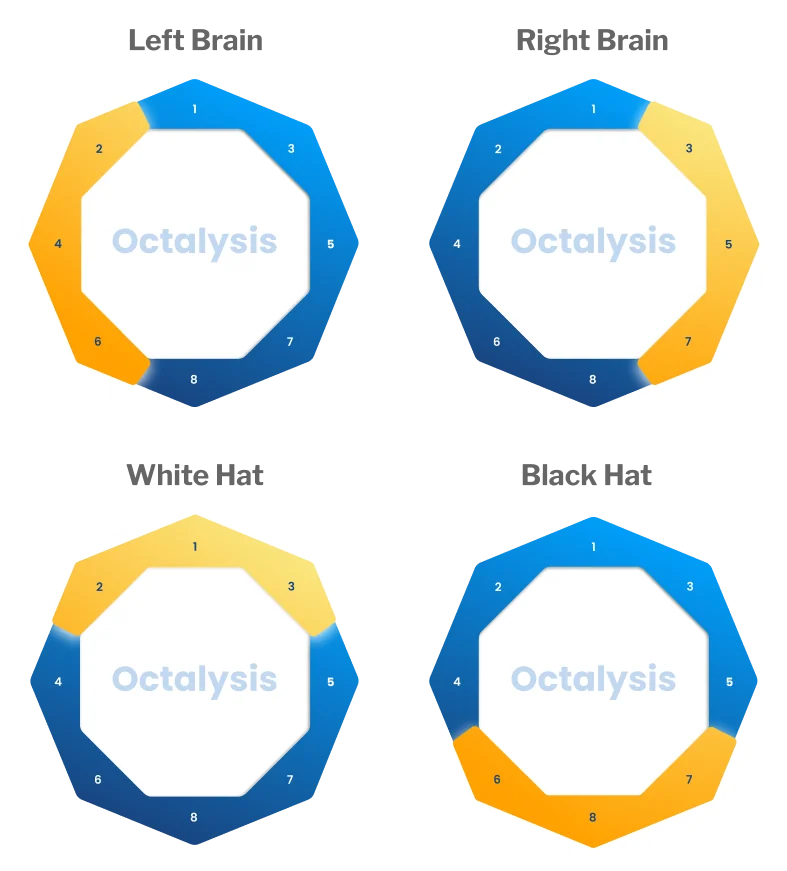
Excellent for driving short‑ to mid‑term behavior change and making progress visible in dashboards, leaderboards, and KPIs.
These include Development & Accomplishment and Ownership & Possession, expressed through points, rewards, and clear performance targets.
Make the experience itself enjoyable through creativity, collaboration, and exploration, which is essential for long‑term engagement and loyalty.
Includes Empowerment of Creativity & Feedback, Social Influence & Relatedness, and Unpredictability & Curiosity.
The top of the Octalysis Framework (Epic Meaning & Calling, Development & Accomplishment, Empowerment of Creativity) makes people feel empowered, in control, and fulfilled.
These drives are ideal for building sustainable loyalty, brand trust, and healthy long‑term habits.
The bottom of the framework (Scarcity & Impatience, Unpredictability & Curiosity, Loss & Avoidance) creates urgency, FOMO, and “I have to act now” pressure.
They suit launches, campaigns, and critical conversion moments, and should always be combined with other drives.
Octagon Your Product
Move each slider from 0 (not present) to 10 (the experience is built on it). The chart updates as you go. Nothing is saved or sent.
We believe Octalysis can change the world for the better. Our motto:
Great products are designed for every step of the user journey. The Octalysis Framework applies the 8 Core Drives across four Experience Phases so you can influence Acquisition, Activation, Retention, and Loyalty with one coherent strategy.

Octalysis describes the user experience through the lens of four distinct phases, also referred to as “The 4 Phases of a Player’s Journey”. These phases are Discovery, Onboarding, Scaffolding, and Endgame.
1
The Discovery Phase covers everything that happens before a user truly tries your product: how they first notice you, come to care, and decide to give you a first click. This is where Epic Meaning, Social Influence, and smart Scarcity campaigns give people a reason to act, lifting qualified sign‑ups and lowering cost per acquisition.
See how Octalysis Discovery design helped LATAM Airlines double key loyalty metrics.
2
The Onboarding Phase starts the moment someone first uses your product and ends when they feel competent, confident, and ready to play for real. Here, Development & Accomplishment, Ownership, and gentle guidance design turn confusing first‑time flows into quick wins, raising activation rates and reducing early churn.
How we redesigned onboarding to boost BitDegree activations and completions.
3
Scaffolding is the main journey: the repeated actions users take week after week to reach their goals. Octalysis design in this phase leans on Empowerment of Creativity, Social Influence, and meaningful progress structures to keep the core loop fresh, which directly improves retention, frequency, and depth of engagement.
See how Scaffolding design helped a banking client generate over $1B in new value.
4
The Endgame Phase is when users have “seen it all” once and continue because of status, mastery, contribution, and relationships. Octalysis focuses on Social Influence, Epic Meaning, and Loss & Avoidance here to turn veterans into mentors, advocates, and high‑value customers who stay, spend, and refer at above‑average rates.
See how Octalysis Endgame design helped Procter and Gamble raise revenue 28.6% above its historical performance, in a program now in its fifth year.
As the leading consultancy applying the Octalysis Framework, The Octalysis Group runs each engagement end‑to‑end, from first audit to full roll‑out. This is how we do it:

Our team will listen to your engagement challenges and decide if we are the best match.
Talk to UsQ&A about The Octalysis Framework
Octalysis is a behavioral design methodology created by Yu-kai Chou that sorts human motivation into eight Core Drives. Teams use it to design products, services, and workplaces that keep people engaged over the long term.
Points, badges, and leaderboard approaches work at the level of surface mechanics. Octalysis focuses on the psychological Core Drives behind motivation.
It includes both:
The design work starts by diagnosing which combination of drives produces the specific behaviors you want.
The Octalysis Group has applied the framework for companies including Microsoft, LEGO, Salesforce, Pfizer, and Booking.com.
Yes. Yu-kai Chou consolidated decades of behavioral science research into Octalysis, including Self-Determination Theory (Deci & Ryan), the Fogg Behavior Model, Hooked (Nir Eyal), and behavioral economics.
Teams use the resulting framework to diagnose and design motivation in real-world products.
A practitioner analyzes a product or experience through each of the eight Core Drives to identify what is currently motivating (or demotivating) users.
The framework then guides the design of targeted interventions that strengthen underrepresented drives and balance White Hat (long-term, feel-good) with Black Hat (urgent, compelling) motivation. The result is an experience that keeps users engaged over the long term, with less reliance on short-term extrinsic rewards.
White Hat Drives (Core Drives 1, 2 and 3) make users feel in control and purposeful, which sustains long-term engagement.
Black Hat Drives (Core Drives 6, 7 and 8) create urgency and prompt immediate action, but can cause anxiety if overused. Core Drive 5 (Social Influence) sits in the middle.
The Octalysis Group applies the framework across three primary domains: product engagement (improving retention, onboarding, and user experience), employee motivation (sales performance, training, and workplace culture), and loyalty program design (shifting from transactional points systems to emotionally resonant engagement). Each engagement begins with an Octalysis Audit that scores the product across all eight Core Drives, followed by a design phase that targets the weakest motivational gaps.
Tell us about your platform and we’ll show you which Core Drives it is missing.
Case studies
Education And Technology
Gamified learning platform with clear learning journeys, deepening learning outcomes and reducing reliance on first-line support functions.
90%+Learners actively progressing

Loyalty
Gamified loyalty experience with personalized missions and rewards, leading to record-breaking engagement and conversions.
+153%Increase in credit card acquisitions


Fast-moving Consumer Goods
Gamified sales platform transforming reps into virtual traders, boosting engagement and performance across 19 countries. Best Gamification Award.
+28.6%Increase in sales revenue
For an immediate response, please send us an email via: joris@octalysisgroup.com
or
Thank you. Your message has been sent and we will reply soon.