
- Home
- Learning and Development Gamification: Corporate Training and Learning Platforms People Want to Complete
Learning and Development Gamification: Corporate Training and Learning Platforms People Want to Complete
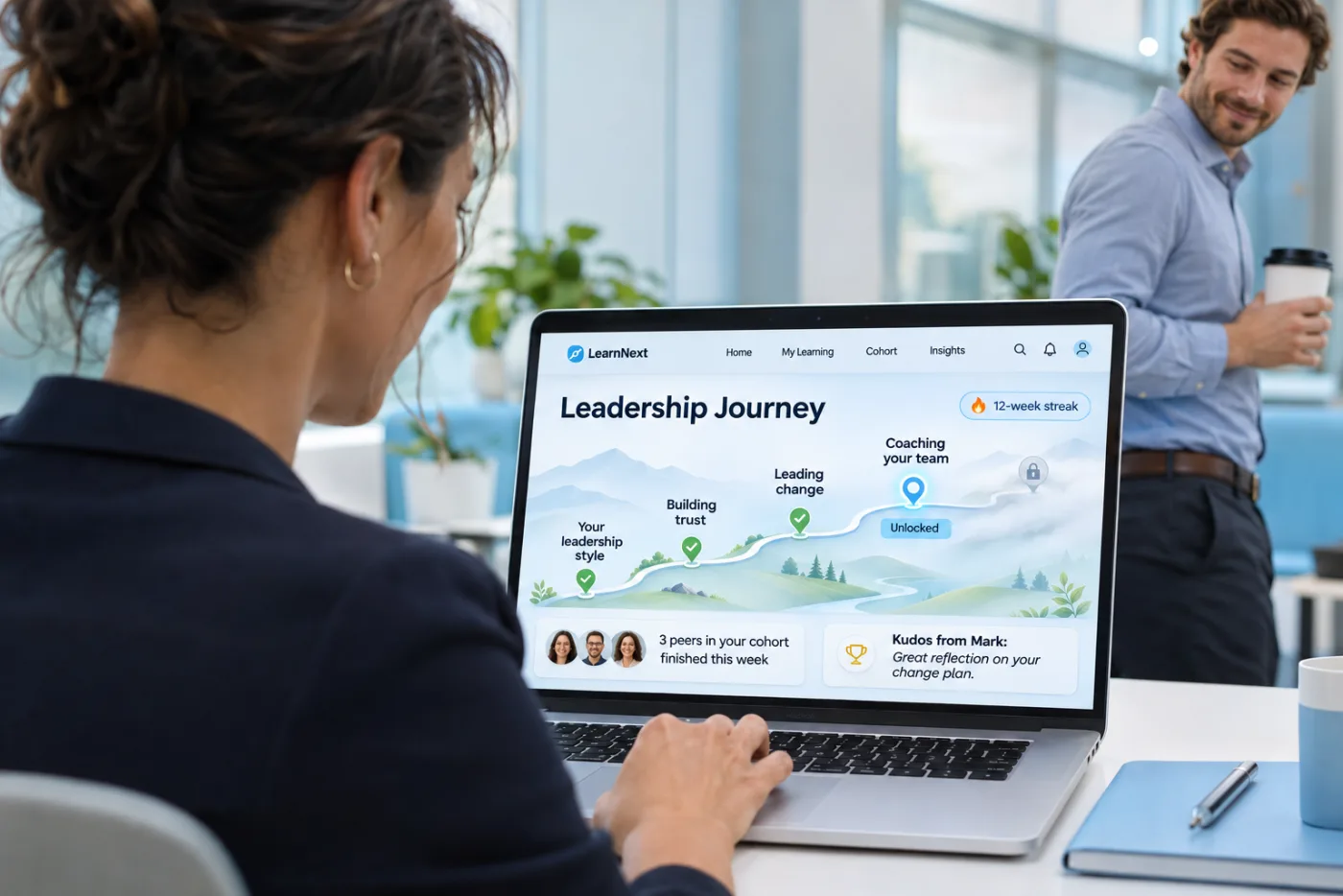
We design corporate training, courses and learning platforms that people start by choice, return to and complete.
The Octalysis Group is the world’s leading consultancy in behavioral design and gamification. We design gamified learning experiences for heads of Learning and Development, product leaders at learning platforms and education providers. We work with your team to agree which metric has to move, such as course completion, learners returning for another course or active progress. Then we design an experience that makes people want to take the actions behind it.
For BitDegree, our design produced a 350% increase in course completion and a 400% increase in returning users taking multiple courses. For Microsoft Azure, we turned the linear library behind Microsoft Learn into a learning ecosystem in which over 90% of learners are actively progressing. Both were designed with the Octalysis Framework, created by our co-founder Yu-kai Chou.
Why learners enroll and do not finish
Most learning is built as a list: a course, its modules, a quiz and a certificate. Every learner gets the same line, whatever draws them to the subject. The content can be excellent and the platform easy to use, and people still stop partway. A product can be logical and intuitive without being engaging.
The usual fix is a layer of points, badges and a completion bar. These have a role. A badge means something when it stands for a challenge overcome, and a bar shows progress. Neither can create the learning experience. BitDegree already rewarded successful course completion before we started, and still wanted higher participation and completion.
A design that only fills progress bars also stays the same while the learner changes. The tenth course works like the first, with more points and more levels. It gets stale and starts to feel like work.
Why copying Duolingo’s streak rarely works for training
Duolingo’s streak works because its users have already chosen to learn a language. The activity is motivating in itself, so a linear, extrinsic mechanic adds direction and visible progress. Training that was assigned to someone does not come with that motivation. A streak there doubles down on the obligation that was already making people stop. The mechanic has to follow from your learners and your subject.
What is gamification in learning and development?
Gamification in learning and development is the use of motivational design learned from games to make people want to start, continue and complete learning. It applies to corporate training, education and online learning platforms. It is also called learning gamification, gamified learning or training gamification.
We learn from games because nobody has to play one. The moment a game gets boring, people drop it, so games have had to optimize their design for human motivation. Good gamification does not turn a course into a game, and it does not add game techniques as a layer on top of existing content.
It also does not have to look like a game. Explicit gamification looks and feels like one, as the BitDegree world map does. Implicit gamification uses the same motivational design without the game surface, as LinkedIn’s progress bar does. For a senior audience or a serious subject, the experience we design may not look playful at all.
What we design into a learning experience
We design the motivation around the actions your metric depends on:
- Choice and feedback. Learners try different approaches and see the consequences, so they discover for themselves that they are becoming capable. This is Core Drive 3: Empowerment of Creativity & Feedback.
- Other learners. Teams, communities and learning partners make helping someone else part of progressing. This is Core Drive 5: Social Influence & Relatedness.
- Discovery. Finding the next part of the content becomes part of learning, with surprises along the way. This is Core Drive 7: Unpredictability & Curiosity.
- Paths for different learners. Some people value achievement and comparison, and others value collaboration or the freedom to explore. They stay in one experience, with a journey that suits each of them.
Rewards stay in the design. Recognition communicates an achievement, and an incentive can help someone begin an unfamiliar activity. We design intrinsic and extrinsic motivation together. The motivational psychology and behavioral economics behind these choices are set out in the scientific foundations of Octalysis.
Where we apply it
Corporate training
Corporate learning happens inside a working culture. Hierarchy, bureaucracy and the relationships inside a company affect who takes part and why, so we design with that context included. The same principles drive our employee engagement work. At Navo Orbico, a Procter & Gamble distributor where expensive training programs had low completion rates, we designed a sales program in which each rep’s trading ship stood for their skills and could be upgraded. Our article on making corporate training more engaging shows how choice and discovery can shape a training experience.
Online learning platforms
A platform grows when learners finish a course and come back for the next one. We design how someone meets the subject, makes progress and continues after the first course. BitDegree is the reference case.
Education and course design
For courses and educational programs, we design the journey around the learner, the content and the intended learning outcomes. Participation then has more to offer than moving through a list of required material.
Technical learning and technology rollouts
Microsoft Learn shows the approach at the scale of a full technical library. Where training supports a new system, learning and adoption are closely connected. A course introduces the technology, and the ongoing experience has to make using it meaningful. Our digital transformation service covers that wider journey.
A learning journey that grows with the learner
Motivation changes as people gain experience, so we design for the four Experience Phases of Octalysis.
Discovery is why someone would try the experience at all.
Onboarding teaches the rules and tools. It can be linear and predictable, and it leads to a first achievement the learner is proud of. The feeling we design for is: this is easy, I can do it, I came to the right place.
Scaffolding is the regular journey toward a goal. Here the design opens up, with different strategies for different learners, meaningful collaboration and joyful surprises.
Endgame is what experienced learners do. They need roles suited to what they can now offer, not more beginner milestones. On Microsoft Learn, top performers became community leaders.
How we work with your team
We begin with a review of your objectives. Together we check that the program is aimed at the right business metrics in the right order of priority. Many clients revise their priorities at this stage, before anything has been built. From the metrics we define the desired actions, the specific things learners need to do. Both go into the Strategy Dashboard.
Then we look at who your learners are. We define player types from your actual audience and use the 8 Core Drives of the Octalysis Framework to understand what motivates each of them.
The outcome is a detailed human-focused design strategy, worked through to a feature list and screen-level wireframes that your own team or technology partner can build. Your content stays at the center. At BitDegree, the existing courses were given a new context.
We measure against the metrics agreed at the start. Completion, returning learners and time spent are different measures, and we report each under its own label.
Who you work with
The Octalysis Group is the world’s leading consultancy in behavioral design and gamification. Our team has designed gamified and behavioral experiences for more than 175 companies, from Fortune 500 firms to startups.
Learning and development projects are delivered by our expert team of Octalysis specialists, who work from the United States, Latin America, Europe and Asia. The Octalysis Group was co-founded by Joris Beerda, the world’s leading practitioner in Octalysis and an expert in enterprise gamification, and Yu-kai Chou, the creator of the Octalysis Framework. Both are involved in many of our client projects.
Microsoft Learn: from a library of 5 million documents to a learning ecosystem
Microsoft Azure had a linear library of around 5 million documents. We turned it into a gamified learning ecosystem, designed per Player Type.
- Achievers get challenges. Learners motivated by accomplishment have XP, challenges and achievement systems.
- Social learners get company. They have teams, communities and learning partners.
- Feedback follows the subject. After a knowledge check, feedback recognizes progress in the subject itself.
- Top performers lead. High performers become community leaders and contribute beyond their own progress.
Result:
- Over 90% of learners actively progressing

BitDegree: 350% more course completion on an online learning platform
BitDegree already rewarded successful course completion and wanted higher participation and completion. We helped it define a purpose for its gamification elements and connect them to the motivations of its learners.
The design moved away from a linear list of courses. Learning became a path of discovery through a virtual world, with the course content placed on a map. Exercises, assessments and rewards sit within that journey, so finding the next part of the world is part of learning.
Results:
- 350% increase in course completion
- 400% increase in returning users taking multiple courses
- 300% increase in time spent on the platform
350%
BitDegree increase in course completion
400%
BitDegree increase in returning users taking multiple courses
90%+
Microsoft Learn learners actively progressing
If people enroll and do not continue, or finish required material without engaging further, contact us and tell us which metric you need to move and what your learners do today. We will tell you whether we are the right match. More of our work is in our case studies, and the full range of what we do is on our services page.
Already have a project in mind? Let’s work together!
Our team will listen to your engagement challenges and decide if we are the best match.
Get in touchFrequently Asked Questions
Is learning gamification mainly points and badges?
Points and badges can communicate progress or recognize achievement. Our work also designs for meaningful choices, discovery, collaboration and a journey that develops with the learner. The mechanics support that experience rather than defining it.
What results have you achieved in online learning?
The BitDegree case study reports a 350% increase in course completion and a 300% increase in time spent on the platform. The design focused on learner engagement and course completion through a structured learning journey.
Can you improve an existing training or learning platform?
Yes. We work across corporate training, education and online learning. The design considers your learners, content and intended outcomes, then develops an engagement strategy and experience that your team can implement.