
- Home
- Employee Engagement Gamification Consulting for Sales Teams, Training and Internal Programs
Employee Engagement Gamification Consulting for Sales Teams, Training and Internal Programs

The Octalysis Group is a behavioral design and gamification consultancy. We design gamified employee engagement programs for heads of sales enablement, Learning and Development, HR and innovation who are planning a workplace program or redesigning one that has stalled. We work with your team to agree which business metric the program has to move. Then we design an experience that makes employees want to take the actions behind it, whether that is selling, finishing training, keeping CRM records accurate or contributing ideas.
At Caixa Econômica Federal, voluntary participation rose from 10% to 92% and net income grew 48% during our program. At Navo Orbico, a Procter & Gamble distributor, revenue rose 28.6% and 99.5% of eligible employees joined a program nobody was required to use. Both were designed with the Octalysis Framework.
The framework was created by Yu-kai Chou, who founded The Octalysis Group with Joris Beerda, an expert in enterprise gamification. We are a consultancy, not a software vendor: we design the program, and your own team or technology vendor builds it.
When the bonus stops producing extra effort
Most workplace programs we are asked to redesign already have incentives. There is a cash bonus, a KPI email and a spreadsheet ranking. Sometimes there is also a layer of points and badges. At some stage these stopped producing additional effort. The sales force treats the bonus as part of its pay, and the points are attached to work that has not changed.
The usual response is to add more of the same: a bigger prize, another badge, a leaderboard for everyone. A ranking motivates the people who believe they can reach the top and can discourage everyone else. Extrinsic rewards get people started, but they cannot carry a program alone.
The work that suffers first is the work few people see. CRM entries are skipped and stock checks are postponed. Training that was paid for and announced is left unfinished. Meanwhile, the most experienced employees have the most to offer and nothing new to do.
The problem is the design, whatever tool it runs on. A points-and-badges layer behaves the same way on any platform. So we design the motivation into the work itself:
- Several ways to advance: employees choose how they progress.
- Useful collaboration: helping a colleague helps both people move forward.
- A link to the team: each person can see how their own results affect the team’s.
- Room to grow: the experience keeps changing as people gain experience.
What is employee engagement gamification?
Employee engagement gamification is the use of motivational design learned from games to make employees want to take the actions that business results depend on. It is also called workforce gamification, HR gamification or gamification in the workplace. When clients ask for it, they usually mean behavioral activation: more people taking the actions the business depends on.
We learn from games because nobody has to play one. People drop a game the moment it gets boring, so games have had to optimize their design for human motivation. We call designing for that kind of voluntary motivation human-focused design.
Gamification in the workplace does not have to look like a game
- Explicit gamification looks and feels like a game, as the trading ships at Navo Orbico did.
- Implicit gamification uses the same motivational design without feeling like a game. LinkedIn’s progress bar is an example.
For serious settings such as banking, a program we design may not look like a game at all.
Employee gamification examples: client results
We designed both programs below for large sales forces whose cash bonuses had stopped producing additional effort. More examples are in our case studies.
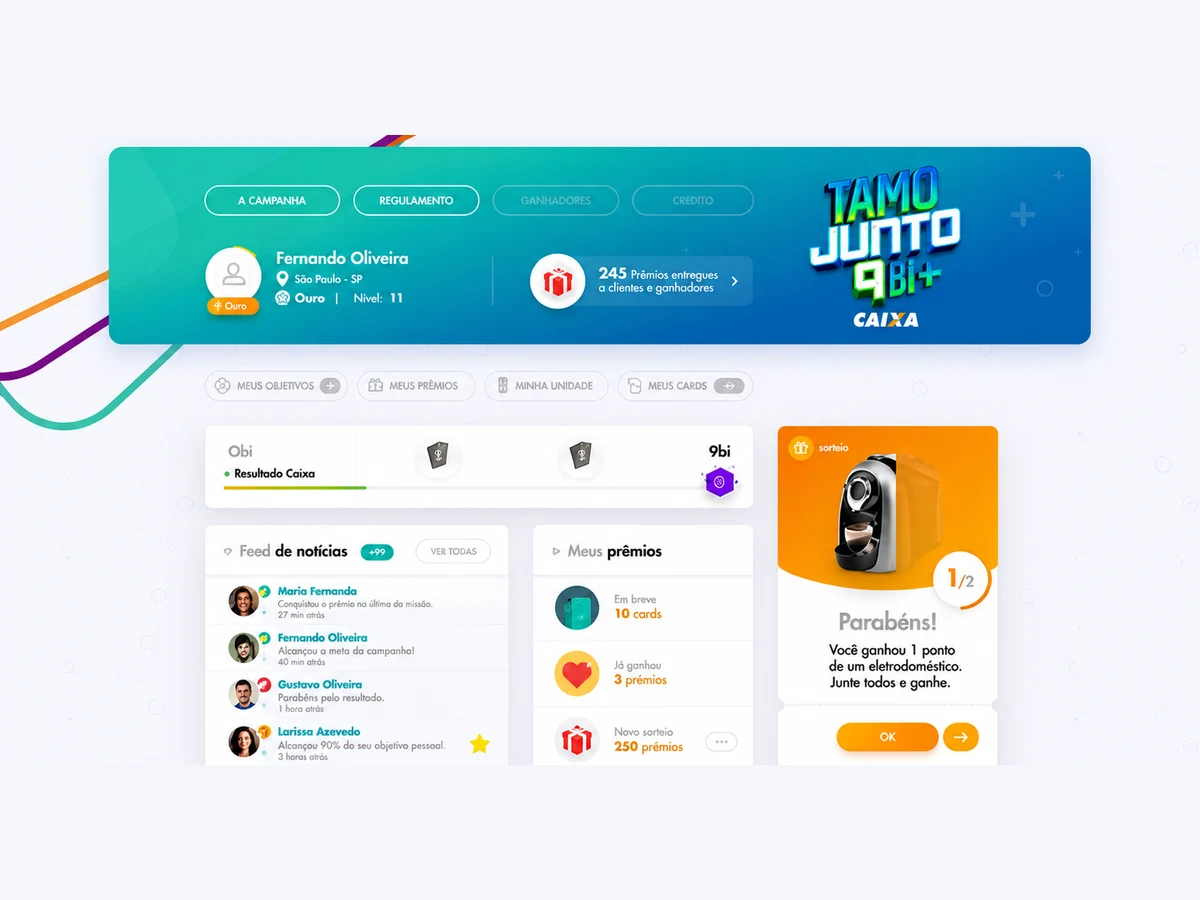
Caixa Econômica Federal: sales force gamification in banking
Caixa, a Brazilian public bank, had about 83,000 employees in 4,500 branches. Spreadsheets, KPI emails and cash bonuses had stalled. We studied the motivational profiles of the sales force before choosing any mechanic.
The resulting program, “Tamo Junto 9Bi+” (Together We Reach 9Bi+), was built around a shared national goal, so branches cooperated and did not compete with each other. Individual goals returned either a small instant reward or a collectible piece. Employees traded pieces to complete sets, so helping a colleague had a practical use.
Results at Caixa during the program:
- Net income rose from R$8.6 billion to R$12.7 billion, an increase of 48% and about US$1.06 billion in added net income
- Voluntary participation rose from 10% to 92%, with 77,000 active users
- The platform recorded 7 million visits
- Caixa moved from number two to the number one public bank in Brazil within a year
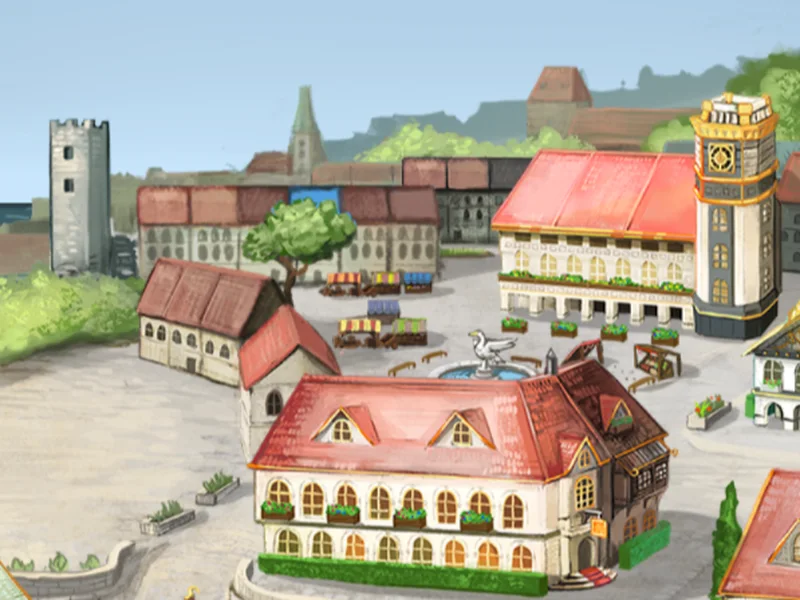
Navo Orbico: sales gamification for a Procter & Gamble distributor
Navo Orbico distributes Procter & Gamble brands and operates in 19 countries. It had stagnant sales, rising turnover and sales teams tired of cash bonuses. CRM entry and stock checks were being neglected, and expensive training programs had low completion rates. Field reps felt cut off from headquarters and from each other.
We turned those problems into the actions the program was designed for. Sales reps became captains of their own trading ships, their territory became the open sea, and their clients became colonies to trade with. Reps upgraded their ships, which stood for their skills, and chose their own strategy for growth.
The team hub was a virtual Port City that suffered natural disasters when collective targets were missed, which tied each rep’s results to the team’s. The program ran on top of Navo Orbico’s existing CRM.
Results at Navo Orbico:
- Revenue rose 28.6% versus historical performance
- The KPI for sales input activities, including CRM entry and stock checks, improved by 60%
- Social interaction between employees rose 300%
- 99.5% of eligible employees adopted a program that was not compulsory
- The program won Best Gamification Project at the Europe Gamification Awards
28.6%
P&G revenue versus historical performance
+48%
Caixa net income
92%
Caixa participation, up from 10%
Has your program stalled at bonuses, points and badges? Contact us and describe where it stalled.
Where we apply employee gamification
We work on any internal program where a business metric depends on what employees choose to do. Five situations come up most often.
Sales team gamification and sales incentives
The most common brief is incentive fatigue. We keep the bonus and stop relying on it alone. Reps get several ways to advance, a reason to help each other and a visible link between their own results and the team’s. Caixa and Navo Orbico both started here.
Corporate training gamification
Most corporate training asks for effort now and promises a benefit later. We design to shorten that distance:
- a win in the first session
- progress that counts for something outside the course
- a chance to use the new skill at work soon afterward
Employee onboarding and retention
New employees decide early how much effort a workplace deserves, and many onboarding programs open with forms and logins. We design onboarding as a guided first experience with an early win. We design for experienced employees just as carefully, because people with nothing new to do are the ones who disengage.
CRM and data quality
Accurate records are work that nobody is thanked for. We make actions such as entering a visit or updating a record visible and give them consequences inside the experience, so that accurate data helps a person and their team advance. This works best built on top of the CRM itself.
Innovation and internal initiatives
Idea programs and change projects often launch with strong attention and lose participation once the launch is over. We plan what people do in month six as carefully as what they do in week one. We also plan what contributors get back: a visible response to their contribution and a role that grows with their experience.
How we work with your team: the five-step Octalysis design process
We begin with your objectives. Together we agree the business metrics the program has to move, the desired actions that move them and who needs to take those actions. This goes into the Strategy Dashboard, the document every later decision is tested against. We review it with you before any design work, because priorities are easier to change before design begins than after launch.
Then we look at the organization itself: its culture, hierarchy, bureaucracy and political situation. The same mechanic can land very differently in a 150-year-old public bank and in a field sales team. So we look at how your people experience competition and collaboration before choosing rankings or shared goals.
People in the same role are also motivated by different things. We don’t use Bartle’s four player types, which were made for a specific kind of game and generalize badly to a workforce. We derive player types from your actual employees, usually by mapping them on the two dimensions that most divide how they approach the work. The result is one experience with a relevant path for each dominant player type.
From there the design moves through four further steps:
- Brainstorming. We generate design ideas for each desired action, using the Core Drives of the Octalysis Framework.
- P&E Feature List. We rank each idea by Power and Ease: how strongly it motivates and how easy it is to implement.
- Battleplan. We map which features each group of employees meets, and when.
- Wireframes. We turn the Battleplan into screen-level designs that are ready to build.
A consultancy, not a software vendor
We do not sell a platform or a software licence. We design the employee experience, and your own team or technology vendor builds it, often on top of systems you already run. Where possible the program runs in the tools employees already use, so they do not have to visit a separate one.
Scope, timeline and cost
Scope, timeline and cost depend on four things:
- how many business metrics and desired actions are in scope
- how many employees and countries the program covers
- how many player types the workforce contains
- which existing systems the design has to sit on
One sales team in one country is a different project from a workforce of 83,000. We set all three with you once we know the metric and the audience.
Designing for the new hire and the ten-year veteran
Motivation changes as people gain experience, so we design every employee program for four phases.
Discovery is how people first hear about the program. We design the announcement as the first step of the experience, so that what people are promised matches what they find.
Onboarding is simple and guided, with as little admin as possible and a win in the first session.
Scaffolding is the long middle. Points, levels and rewards first show people what to do and that it counts. A program made only of that loop gets stale fast, so we add intrinsic design:
- several ways to advance
- collaboration that helps people progress
- surprises
- a sense of being part of something bigger
Endgame is what veterans do. Some become internal ambassadors who help onboard new colleagues, with real things to do and recognition for doing them. Others prefer to deepen their expertise.
Urgency without manipulation
The Octalysis Framework distinguishes White Hat from Black Hat design. White Hat design makes people feel powerful and in control, and the long-term pull of a program comes from it. Black Hat design creates urgency, for example through a deadline or the threat of losing something. A program needs some of it to get people to act today.
We never let a Black Hat threat end in a loss people cannot recover from. Any setback needs a way back, or people feel out of control and drop out. Over the life of a program, the design shifts toward intrinsic and White Hat motivation.
Measuring whether the program works
We measure against the business metrics agreed before design begins, compared with a baseline recorded before launch. We read four things together:
- Business results against the baseline. A common baseline is the organization’s own historical performance, as with Navo Orbico’s 28.6% revenue increase.
- The behaviors the design targeted. At Navo Orbico these were sales input activities and social interaction between employees.
- Voluntary participation. High participation in a program people are free to ignore is a much stronger signal of motivation than compulsory use.
- Return over time. Launch-week curiosity can make any program look good, so we look at whether people keep coming back in the short, medium and long term.
Why The Octalysis Group
Since 2013 our gamification consultants have done design work with more than 175 companies, from Fortune 500 firms to startups. Our program for Navo Orbico won Best Gamification Project at the Europe Gamification Awards.
The founders
- Yu-kai Chou created the Octalysis Framework and wrote Actionable Gamification: Beyond Points, Badges, and Leaderboards.
- Joris Beerda is the world’s leading practitioner in Octalysis and an expert in enterprise gamification. His expertise covers employee engagement and sales team gamification.
We use the same process for customer-facing work, including loyalty programs. See all of our gamification consulting services or read more about our team.
Talk to us about your program
If you are planning an employee, sales-force or internal-program initiative, or redesigning one that has stalled, tell us which business metric matters and who needs to act for it to change. We will tell you whether we are the right team for it.
Contact us to start that conversation.
Already have a project in mind? Let’s work together!
Our team will listen to your engagement challenges and decide if we are the best match.
Get in touchFrequently Asked Questions
How does gamification improve employee engagement?
Points and bonuses are extrinsic and Left Brain, and they only go so far. Ownership and Possession (Core Drive 4) is part of that group too, so collecting things is still extrinsic motivation. We add intrinsic, Right Brain design on top. Empowerment of Creativity and Feedback (Core Drive 3) gives people different strategies to advance, so they feel agency. Social Influence and Relatedness (Core Drive 5) gives them meaningful social collaboration to progress. Unpredictability and Curiosity (Core Drive 7) means there is always something new to discover, with joyful surprises on a regular basis. We also make sure the journey evolves with seniority, and we design the endgame for your most experienced people, which almost every program forgets.
What results has Octalysis achieved for employee engagement?
Navo Orbico, a Procter & Gamble distributor, reported a 28.6% revenue increase versus historical performance, 60% KPI improvement and 300% more social interaction. At Caixa Econômica Federal, net income rose 48%, from R$8.6 billion to R$12.7 billion, about US$1.06 billion in added net income. Employee participation rose from 10% to 92%. The full results are on each case study page.
Does gamification work when employees don’t have to take part?
It can. The Navo Orbico experience was not compulsory, and adoption reached 99.5%. Voluntary participation helps show whether people choose to use the experience.