
- Home
- Case Studies
- Porsche Motors
Case study · Automotive
Porsche Motors Case Study: 5.4 Extra Minutes Daily Engagement with Gamified Loyalty
- Client
- Porsche Motors (Volkswagen Group)
- Product
- BONEO app
- Industry
- Automotive
- Core Drives
- 34567
Transforming “Drivers” into “Daily Active Users”
The automotive industry is in a race for attention. According to McKinsey & Company, the future of mobility revenue lies in software-driven services and recurring customer engagement.
However, most car apps suffer from low retention because they focus solely on utility (Function-Focused Design): locking doors or checking battery status.
Porsche Motors, part of the Volkswagen Group, sought to break this cycle. They partnered with The Octalysis Group to create a gamified loyalty solution that would motivate users to interact with the brand every single day, regardless of whether they were driving.
The Challenge
The Challenge: The “Utility Trap” in Automotive Apps
Porsche faced a common challenge among car brands: how to drive daily digital engagement and long-term customer loyalty using rewards programs.
Before Octalysis, the client had designed a standard functional app: screens, buttons, and status updates. While functional, it lacked the psychological hooks to drive habit formation. The vision was to replace pure functionality with a human-focused design that motivates and excites users throughout their customer journey.
The challenge was clear: How do you get a user to open a car app when they aren’t in the car? To solve this, we needed to shift the KPI from “usability” to “motivation.” Making something easy to use is Human Centred Design; it does not mean anybody feels motivated to use it. Human Focused Design goes further and designs for that motivation.
The goal was to build a Mobility as a Service (MaaS) ecosystem that integrated:
- Daily interaction loops.
- Social connectedness among drivers.
- Integration of third-party mobility services.
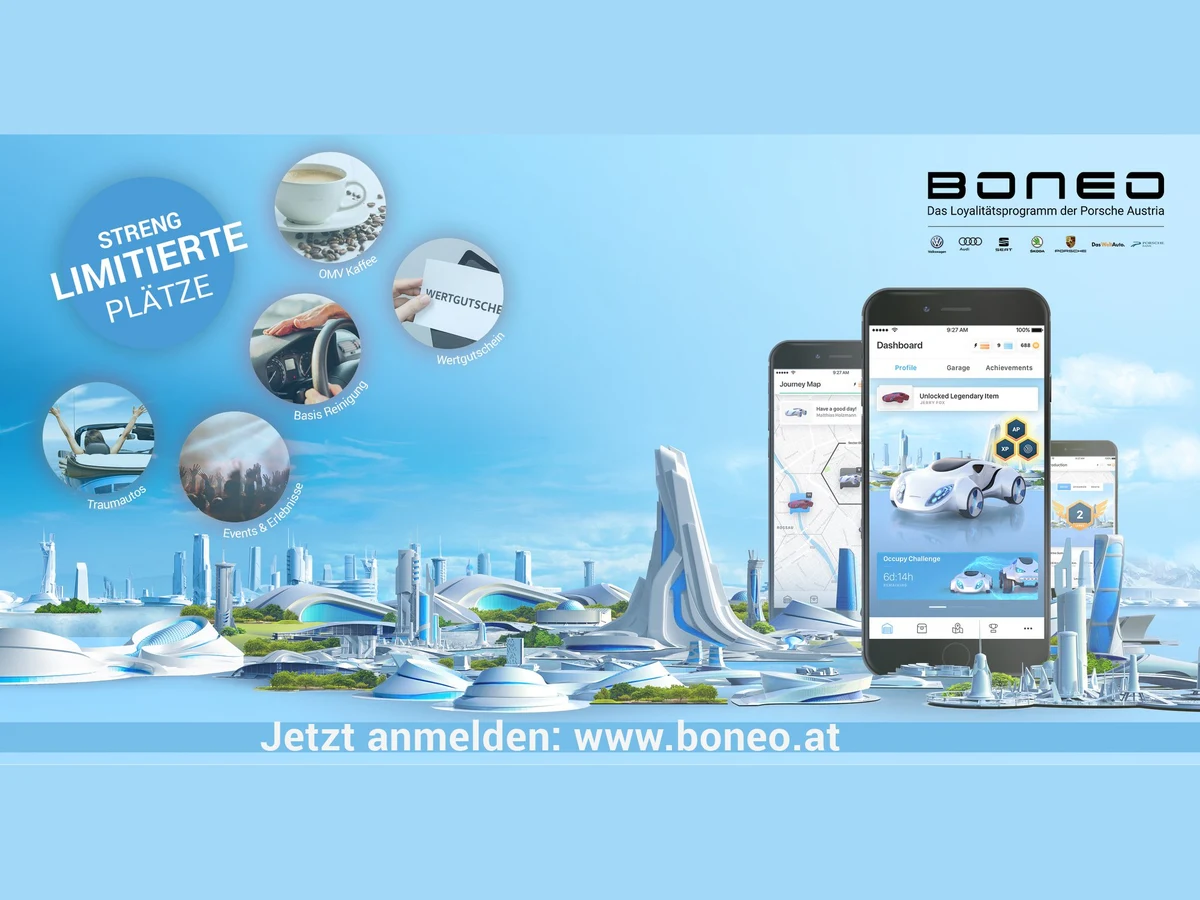
Automotive industry’s first gamified loyalty program
Strategy: Gamification for Engagement and Brand Loyalty
Octalysis implemented a robust gamification strategy for automotive loyalty programs. The project began by clarifying business goals: higher daily active engagement, fun social touchpoints, and measurable impact on brand loyalty.
Using The Octalysis Strategy Dashboard, every user action, feedback mechanism, and incentive was mapped to maximize digital interaction and increase daily app usage. Through this process, we came to know exactly what our client wanted from the new Reward and Loyalty Program design:
- A fun, non-linear experience
- Room for inclusion of multiple touchpoints for mobility services integration
- Meaningful and engaging social interaction
Sign-up and the first experience
A reward program first needs people to join. The BONEO marketing website contrasted people having fun in their car with people bored in traffic: “Now you can have fun and earn rewards. Even in traffic!” Because the number of users who could join the pilot in Austria was limited, sign-ups were driven by Core Drive 6: Scarcity & Impatience. After signing up, users received a secret code in the shape of a number plate, which opened the BONEO app.
Most loyalty programs onboard you matter-of-factly: your status, your first points, and that is it. In BONEO, entering the secret code immediately earned Award Points, and within seconds the user’s first car rolled into view: their first Carvatar. Every driver then did a virtual test drive on the map to discover the core activity loop, without getting into a car.
Now we were ready to start thinking of features to drive user motivation for the desired actions needed to impact the business outcomes and the final desired end state. This strategy usually covers the whole customer journey, from first getting to know about the program to using it on a regular basis.
The Solution
The Solution: The “BONEO” Gamified Ecosystem
We engineered the “BONEO” app, creating a layer of digital engagement that sits on top of the physical driving experience.


Rewards and Benefits: Driving with Perks
The essence of any loyalty program lies in its rewards, and this program was no exception. However, what set it apart was the sheer variety and value of the rewards on offer. By simply driving their car, users could unlock a range of benefits. From practical rewards like free car cleaning to luxurious perks like VIP event tickets, the program catered to a wide range of user preferences.
One of the standout rewards was the opportunity to use an elite Porsche car, a dream for many automobile enthusiasts. And for those who enjoyed a hot coffee during their drives or a cold drink on a sunny day, the program had them covered too.
The message was clear: loyalty to the brand wasn’t just about points; it was about enhancing the overall driving experience.
Results
The Impact: Unprecedented Engagement Metrics
The transition from functional to human-focused design yielded results that vastly outperformed industry averages for automotive customer experience.
5.4 min
Time spent daily in app interaction with brand
90%
Daily Active Users
90 million
Worldwide User Base for Volkswagen Group
- 5.4 Minutes Daily Engagement: Users spent an average of over 5 minutes per day in the app (not allowed to use while driving), a metric typically reserved for social media, not utility apps.
- Touchpoint Interaction increased 300%: Mobile services, Insurances, Food and Beverage, Gas Station Services, Garage Services.
- 90% Daily Active Users (DAU): In pilot phases, the app achieved near-total retention, proving that gamification successfully bridged the gap between the driver and the brand.
- Scalability: Designed to scale to the Volkswagen Group’s 90 million global users, establishing a blueprint for the future of the Connected Car.
Strategic Takeaways for Mobility Leaders
Most loyalty programs are linear, and in essence bribe users to do more of the desired actions. This makes most loyalty programs transactional rather than motivational. It leads to short term bursts of engagement. But it almost never leads to long-term and deep engagement.
The trick is to create a design that offers different strategies for different users. A journey that has meaningful social collaboration. And an experience that has daily joyful surprises along the way. In short:
- Digital Twin Value: Users value digital assets (Core Drive 4) when they enhance the experience, not just decorate it.
- Socializing the Drive: Driving is solitary; the app should be social (Core Drive 5). Connecting drivers creates a network effect that locks users into the brand ecosystem.
- Beyond the Dashboard: The most successful automotive apps engage the user outside the vehicle, turning the brand into a lifestyle companion.
By integrating gamification, social community features, and digital rewards, Volkswagen and Porsche became leaders in automotive loyalty strategy. Their success sets a reference point for other car brands seeking to maximize digital engagement and ROI through advanced loyalty programs.
Internal Resources
- The Octalysis Framework
- Octalysis for Automotive & IoT
- Core Drive 4: Ownership & Possession
- The full design story: How Octalysis helped revolutionise the Volkswagen Group Loyalty Program
- Why Most Loyalty Programs Aren’t Actually Loyalty Programs
- Other loyalty projects: the LATAM Airlines case study and the La Quinta case study, and all projects by business problem in Gamification Examples
Frequently Asked Questions
Q&A about gamification for automotive loyalty apps
How does gamification boost engagement in automotive loyalty apps?
Gamification creates interactive experiences (avatars, challenges, random rewards) that keep users coming back daily, increasing both engagement and brand loyalty. Porsche and Volkswagen’s program saw 90% daily active user rates and a projected reach of 90 million customers, setting a new industry benchmark for loyalty and engagement.
What is the difference between a standard loyalty program and a gamified one?
A standard loyalty program is transactional (Spend $ = Get Points), often leading to low engagement. A gamified loyalty program, like the one designed by Octalysis for Porsche, uses intrinsic motivation (Social Influence, Curiosity, Achievement) to engage users emotionally. This results in “Daily Active Users” rather than just “Transactional Users.”
Why is “Human-Focused Design” important for Mobility as a Service (MaaS)?
MaaS relies on habit formation. If a user doesn’t feel a connection to the service, they will switch to the cheapest competitor. Human-Focused Design builds an emotional switching cost. By making the experience fun, rewarding, and social, users stick with the platform not just for the utility, but for the experience itself.
Drive Your Customer Engagement Further
Don’t let your app be just another utility. Build an engine for loyalty.