
- Home
- Case Studies
- Caixa Econômica Federal
Case study · Banking and Finance
Caixa Econômica Federal Case Study: Generating $1.06 Billion USD through Sales Gamification
- Client
- Caixa Econômica Federal
- Program
- Tamo Junto 9Bi+
- Industry
- Banking and Finance
- Core Drives
- 1457

From 10% Engagement to Market Leadership: The Science of Billion-Dollar Motivation
In banking, “scale” is often the enemy of “agility.” Caixa Econômica Federal, one of Latin America’s largest financial institutions, faced a daunting challenge: aligning over 85,000 employees across 4,500 branches to achieve net income growth from R$ 8.6 billion to R$ 9 billion.
Traditional top-down directives (spreadsheets, KPIs, mandate emails) had stalled, and with engagement hovering at a critical low of 10%, the “engagement gap” threatened to derail their strategic objectives.
Recognizing that standard banking tools failed to tap into human motivation, Caixa implemented Octalysis, the global framework for Human-Focused Design, to engineer a behavioral revolution.
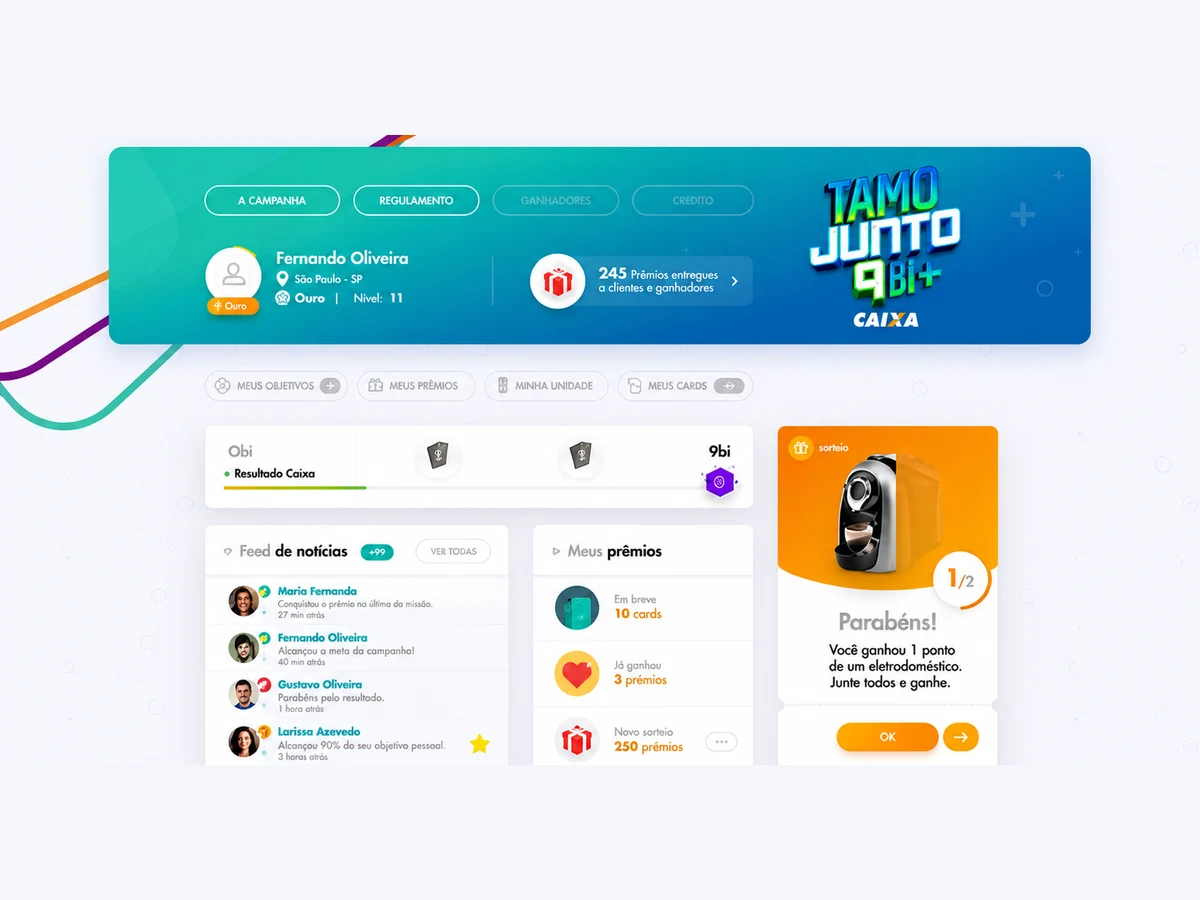
Octalysis principles architected “Tamo Junto 9Bi+” (Together We Reach 9 Billion+), a psychologically optimized ecosystem designed to trigger intrinsic motivation at scale.
By rejecting generic “points and badges” in favor of deep behavioral science, we helped Caixa transform its workforce into a unified sales engine. The result was a 48% increase in net income, about $1.06 billion, and Caixa became the #1 bank in Brazil.
The Challenge
The Challenge: The Engagement Gap in Public Sector Banking
Caixa Econômica Federal is a Brazilian state-owned bank founded in 1861. Scaling engagement in a state-owned bank is uniquely difficult. Unlike agile fintech startups, Caixa operated with a 150-year-old culture, 4,500 disconnected branches, and a workforce suffering from “Incentive Fatigue.”
Gallup research indicates that disengagement in the financial sector is a primary driver of lost productivity, and Caixa was no exception. Standard top-down mandates (KPI emails, cash bonuses) were being ignored, with active participation hovering at a low 10%.
The organization faced a specific behavioral bottleneck: how to unite a fragmented, public-sector workforce behind a singular, aggressive sales goal without triggering resistance.
The Solution
The Solution: “Tamo Junto” – A Cooperative Ecosystem
Octalysis design applied a “White Hat Gamification” strategy, focusing on Core Drive 1 (Epic Meaning) and Core Drive 5 (Social Influence) to transform the sales culture from individual survival to collective conquest.
From second place to #1 bank in Brazil
Design Process
To empower the bank’s sales force to surpass their sales goals, CAIXA decided to create an enjoyable and motivating experience that would turn their routine into something fun.
They recognized that happy and motivated employees would perform their jobs more diligently, directly impacting the bank’s sales.
CAIXA wanted a fresh approach, something that would break the mold of previous attempts with generic gamification platforms that had fallen short.
That’s where the Octalysis Framework did its magic, to design a gamified experience with a focus on understanding human motivation and emotional triggers.
In the analysis phase, the team reviewed its business metrics and conducted an in-depth study of the motivational profiles of its sales force, identifying different Player Types.
Next, they identified the Desired Actions employees needed to take to achieve (and exceed) the annual sales objectives.
In the ideation phase, extensive Brainstorming sessions generated a combination of Octalysis Game Techniques that would maximize CAIXA’s desired results, including:
- Collection Sets
- Virtual Goods
- Group Quests
- Milestone Unlocks


The project was named “Tamo Junto 9Bi+” (Together We Reach 9Bi+), emphasizing unity and cooperation over competition.
Octalysis design created a system where achieving individual goals resulted in small instant rewards or collectible pieces, which, when combined, unlocked larger rewards.
This instilled a sense of common purpose and engagement among the employees.
The CAIXA project also featured a carefully curated selection of rewards to cater to various motivational preferences among employees.
The CAIXA project’s diverse reward system, ranging from immediate incentives like headphones to grand prizes such as trips and cars, played a crucial role in maintaining employee engagement and motivation.
A piece you hold is yours, and people want to complete what they own, which is Core Drive 4: Ownership & Possession. Trading turned a solitary sales job into a social one, which is Core Drive 5: Social Influence & Relatedness. The urgency of collecting and the unpredictability of the rewards sat on top of that White Hat foundation, so employees stayed engaged without burning out.
This system harnessed intrinsic motivators, like unpredictability and social recognition, by promoting the collection and exchange of reward pieces, fostering healthy competition and individual choice.
By addressing both extrinsic and intrinsic motivations, CAIXA’s gamified approach effectively appealed to key aspects of human behavior, ensuring an enjoyable and effective sales experience for employees.
Results
The Impact: A Historic Financial Turnaround
The results of this intervention remain one of the most successful examples of Enterprise Gamification in history. The project obliterated its targets, proving that behavioral science is a hard financial instrument.
48%
Net Income Increase
$1.06 Bn
Added Net Income
92.61%
Participation of 77,000 employees
- $1.06 Billion in Net Income: The bank achieved a 48% increase in net income, jumping from R$ 8.6 billion to R$ 12.7 billion (surpassing the 5% growth goal by 10x).
- #1 Bank in Brazil: This performance propelled Caixa from the #2 spot to the #1 position in the national banking sector.
- 92.61% Employee Engagement: Participation skyrocketed from a baseline of ~10% to over 92%, with 77,000 active users generating 7 million platform visits.
- Speed to Market: The entire gamified ecosystem was rolled out to 4 departments in a record-breaking 3 months, proving that digital transformation can be agile.
Lessons for Financial Leaders
- Unity beats rivalry — when everyone wins together, performance ceilings disappear.
- Collectible fragments > simple points — partial ownership creates stronger emotional investment.
- Speed matters: a flawless 3-month enterprise rollout is possible with the right framework.
- Intrinsic + extrinsic balance scales — grand prizes excited, but shared purpose retained.
- Octalysis works at any size: 80,000+ employees moved as one because motivation was designed, not forced.
Internal Resources
- The Octalysis Framework
- Enterprise Gamification Services
- Our gamification for banking and insurance and Employee Engagement services
- The Engagement Gap: Why Traditional Banks Are Losing to Neobanks and Why Your People Ignore AI Agents
- Other sales and banking projects: the P&G sales gamification case study and the DBS Bank case study, and all projects by business problem in Gamification Examples
Frequently Asked Questions
Q&A about Employee Sales Gamification
Q1: How did gamification generate $1.06 billion in net income?
A1: Gamification generated this result by closing the gap between “strategy” and “execution.” By using the Octalysis Framework, Caixa aligned the daily behaviors of 77,000 employees with high-level financial goals. When engagement rose from 10% to 92%, the collective increase in sales productivity resulted in a measurable $1.06 Billion USD lift in net income.
Q2: Is this approach scalable to other industries?
A2: Yes. The psychological principles used (Social Influence, Ownership, Achievement) are universal. Whether in Retail, Tech, or Manufacturing, Human-Focused Design solves the core problem of “disengaged labor,” which is the primary bottleneck for growth in large enterprises.
Q3: Why did Caixa choose cooperation over competition?
A3: Caixa chose cooperation to build long-term resilience. Pure competition (leaderboards) motivates only the top 10% of performers and demotivates the rest. By using Core Drive 5 (Relatedness) and shared goals (“Together We Reach 9Bi”), they activated the “middle 60%” of the workforce, which is where the bulk of revenue potential lies.
Unlock Your Workforce Potential
Don’t let your strategic goals die in a PDF. Build a movement.