Why Marketing and Branding need to start with Human Motivation 1/2
 Joris Beerda6 September 2019
THE question you’ve been asking yourself everyday
If you are in the marketing field, you constantly wonder how to grab the attention of potential customers:
- “How do I get people to buy my company’s product, rather than my competitors’?”
- “How do I encourage people to do repeated purchases?”
- “And even more importantly, how can I turn my customers into advocates of my brand?”
- These are the challenges you try to solve everyday, right?.
Doesn’t it all boil down to one single question: what really motivates people?
You have probably already come up with some answers yourself: people like the thrill of getting a deal! People act fast when there’s a limited promotion! People buy our products if they trust our brand! And so on and so forth. This is true, BUT ..do these examples answer THE fundamental question? They do not. They only provide some cues.
However, there is a true and complete answer to the question about people’s motivation. It might not be the one you expect, but it can help you solve the marketing problems you are facing. But before I dive into that, we need to take a few steps back.
Gamification is all about motivation
Allow me a few guesses: you have heard of the term gamification. You roughly know it is about applying concepts and mechanics found in games (points maybe? badges?) in non game-contexts (such as marketing). And you have surely also experienced it as a customer – perhaps through some quiz on a Facebook page or by accumulating points in your airline’s loyalty program. After all, Gamification has been trendy for years. Brands like Coca-Cola, McDonalds, Nike, and Starbucks are amongst the first to use it successfully to accomplish their marketing goals.
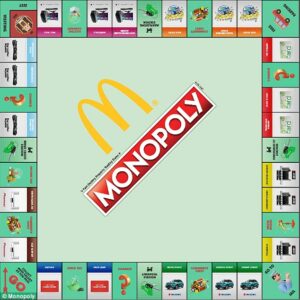
McDonald’s adaptation of the Monopoly Game
So does that mean it’s getting old? Quite the opposite. Driven by the digital transformation and the behaviour of Gen Y and Z, the global gamification market was valued at USD 5.5 billion in 2018, and it is estimated to witness a compound annual growth rate (CAGR) of 30.31% over the forecast period (2019-2024) (Source: ResearchAndMarkets.com).
Despite this growth, and despite our groundbreaking work with clients such as Microsoft, Yahoo, Uber and many more, gamification is still the most powerful yet least understood business strategy. Let’s find out why, by focusing on YOU!.
What motivates YOU?
Allow me two more guesses: My first guess is that you consider yourself a fairly rational human being, always in control of your decisions. Unfortunately, evidence from behavioural science and psychology proves YOU ARE NOT that rational at all (HINT: don’t worry, none of us are).
The vast majority of our decisions are based on emotions, biases and beliefs, and we are highly influenced by the context within which we make that decision. Being “predictable irrational” as Dan Ariely defines us, allows us to make swift choices without the paralysis of extensive analysis.
My second guess is that YOU PLAY GAMES (yes, even serious professionals play games). Whether that’s video-games, sports (gamified exercise) or hide-and-seek with your child.
Ever wondered why you play games? Is it because you get points or badges? Or there’s something else? Something more meaningful? Let me tell you why: games are engaging. They tap into our emotions and fulfil the desires within all of us, such as creativity, competition, achievements, curiosity, mastery, and sense of purpose. In other words, game designers have mastered the art and science of motivation design: they were the first to understand that the only way to craft satisfying and pleasurable experiences (games) and keep people engaged with them (keep playing them), the starting point is understanding what engages our brain.
Welcome to Motivation-based Marketing
Can marketers learn from games? Yes they can. One thing you need to make sense of it all: the Octalysis framework, a proven design methodology that we have tested with over a hundred companies. Instead of just looking at game mechanics, the Octalysis framework looks at the underlying 8 Core Drives of human motivation. In these Core Drives lies the answer to THE question: what DRIVES people?
It takes into account both our rational and logical (for instance our desire for progress, achievement, accumulation) as well as irrational and emotional (for example curiosity, unpredictability and social influence) nature. Learn more about it here.
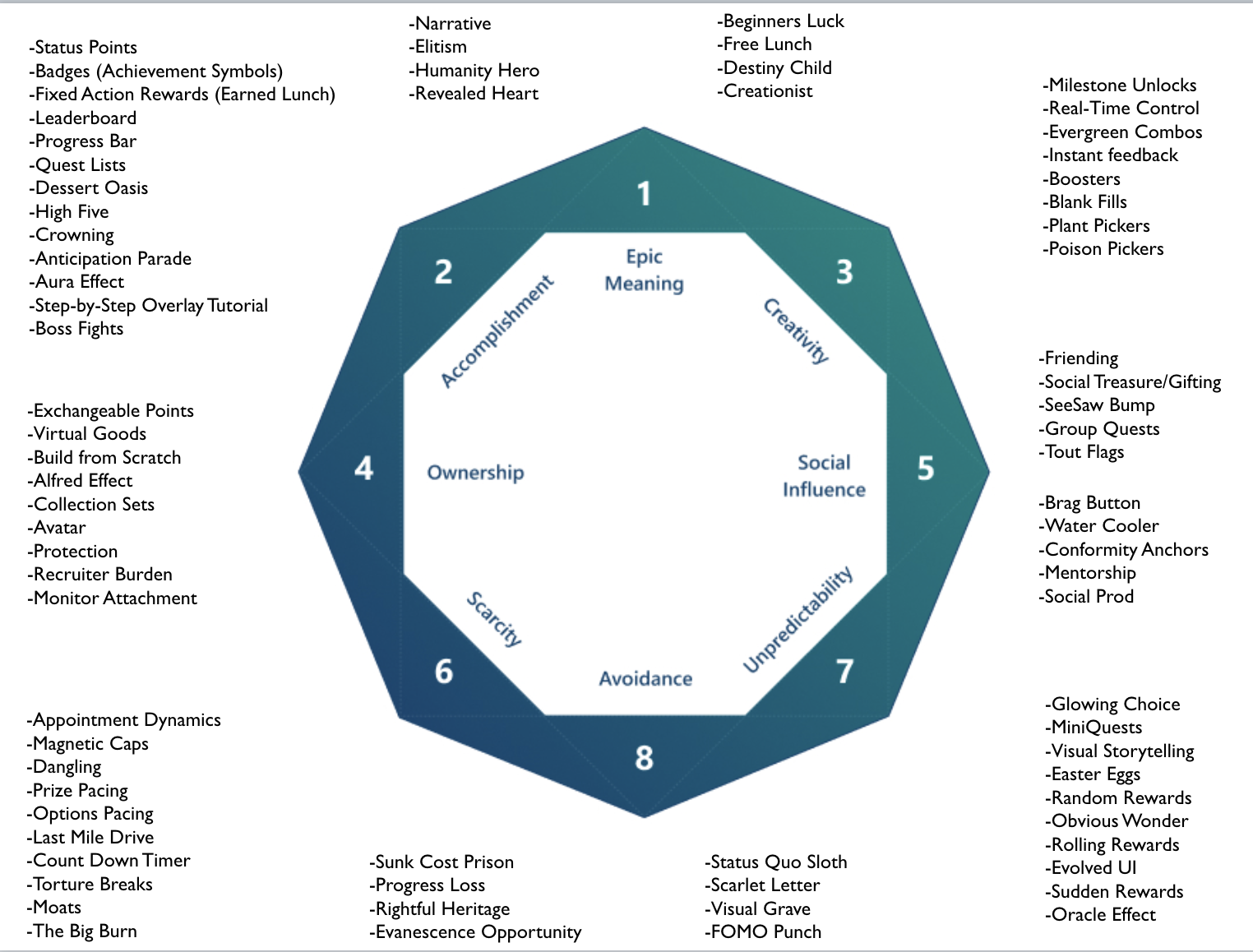
The Octalysis Framework. 8 Core Drives of Human Motivation
This is the tool that as a marketer YOU need to create a pleasurable experience for consumers to keep them attached, and coming back to the product.
Our clients approach us with many different types of marketing challenges and objectives. Therefore every solution needs to be custom-based. Your brand, your customers, your product and your company’s vision will ultimately determine what the gamified solution looks like. Let’s look at a few examples of how companies are successfully leveraging the 8 core drives for motivation-based marketing.
Motivation-based Push Marketing Strategies
A push strategy puts a product in front of consumers to gain brand exposure. You actively seek your customers and then push your products into view. A push strategy often involves interrupting the content the consumer was viewing by using a form of paid advertising. Whether you do this through a digital or an analog experience, in a world overloaded with information, you need to find new, memorable ways to engage your customers. One brand that has done an excellent job when tasked to launch a new product is Samsung.
Case study 1: Samsung’s All Eyes on S4 Campaign.
To launch the Samsung Galaxy S4, Samsung launched a staring contest, powered by the innovative eye-tracking technology in the S4. The team placed the devices at eye-level inside four billboards located in areas of high foot traffic in Switzerland. Passersby who could stare at the screen for 60 minutes without diverting their eyes would win a device (Core Drive 4: Ownership & possession). But it wasn’t that easy (Core Drive 6: Scarcity & Impatience): the brand presented the contenders with lots of distractions, everything from police dogs to arguing couples and even renegade motorcyclists plowing through food vendor stands (Core Drive 7: Unpredictability & Curiosity). Soon the challenge attracted a crowd of people that cheered up the players, turning the whole show into a really fun and memorable experience. We need to thank Core Drive 5: Social Influence & Relatedness for that. Only 13 people won the game, but the real winner was Samsung: The live stream of the event attracted massive viewership and the resulting video went viral. Here some results:
- 1/3 of all people in Switzerland exposed to the product
- 4.1 million views, 19,582 likes, and 136,180 shares on YouTube
- Live stream reached 1.5 million views
All Eyes on S4 Campaign, by Samsung
Case study 2: Sephora’s Swipe it, Shop it
Another interesting gamified experience has been implemented by Sephora with the Swipe it, Shop it feature. Borrowing the swipe feature from Tinder, a customer is able to swipe left or swipe right on a bunch of different beauty looks (think eye-liners, eye-shadows, false lashes, lipsticks, etc.) and then find corresponding products and application tips. This is a combination of Core Drive 7: Unpredictability & Curiosity (what will I see next?) and Core Drive 2: Development & Accomplishment (it’s a match!).
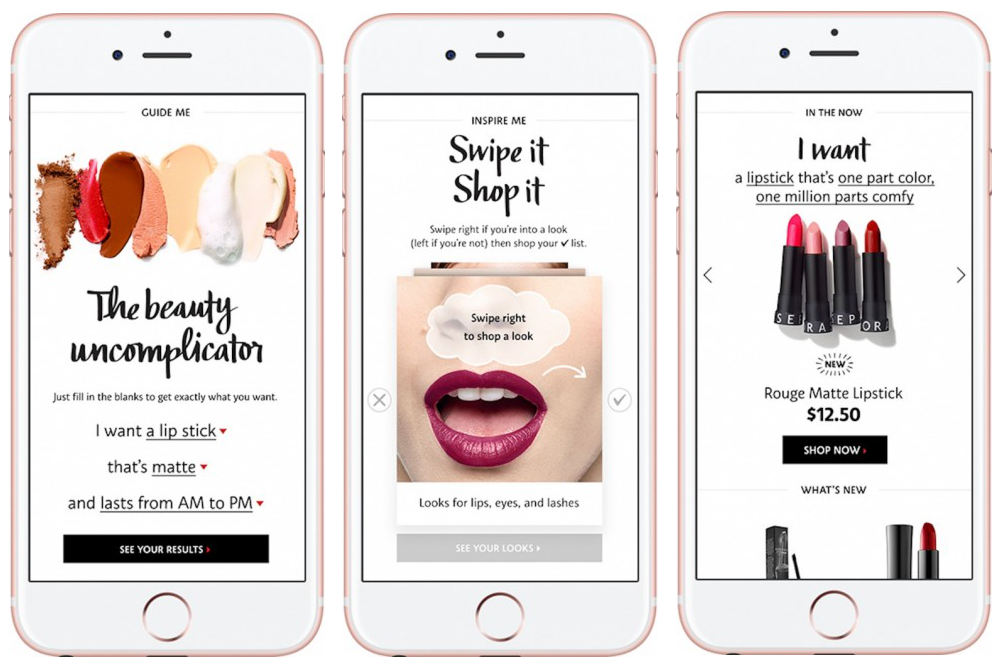
Swipe it, Shop it by Sephora
Another objective could be to attract customers through Pull Marketing Strategies. But.. we’ll talk about it in the next blog post!
Thinking of new ways of engaging your customers and want to know how to do it effectively?
Get in touch with the world’s leading Gamification and Behavioral Science professionals for a FREE consultation: massimo@octalysisgroup.com