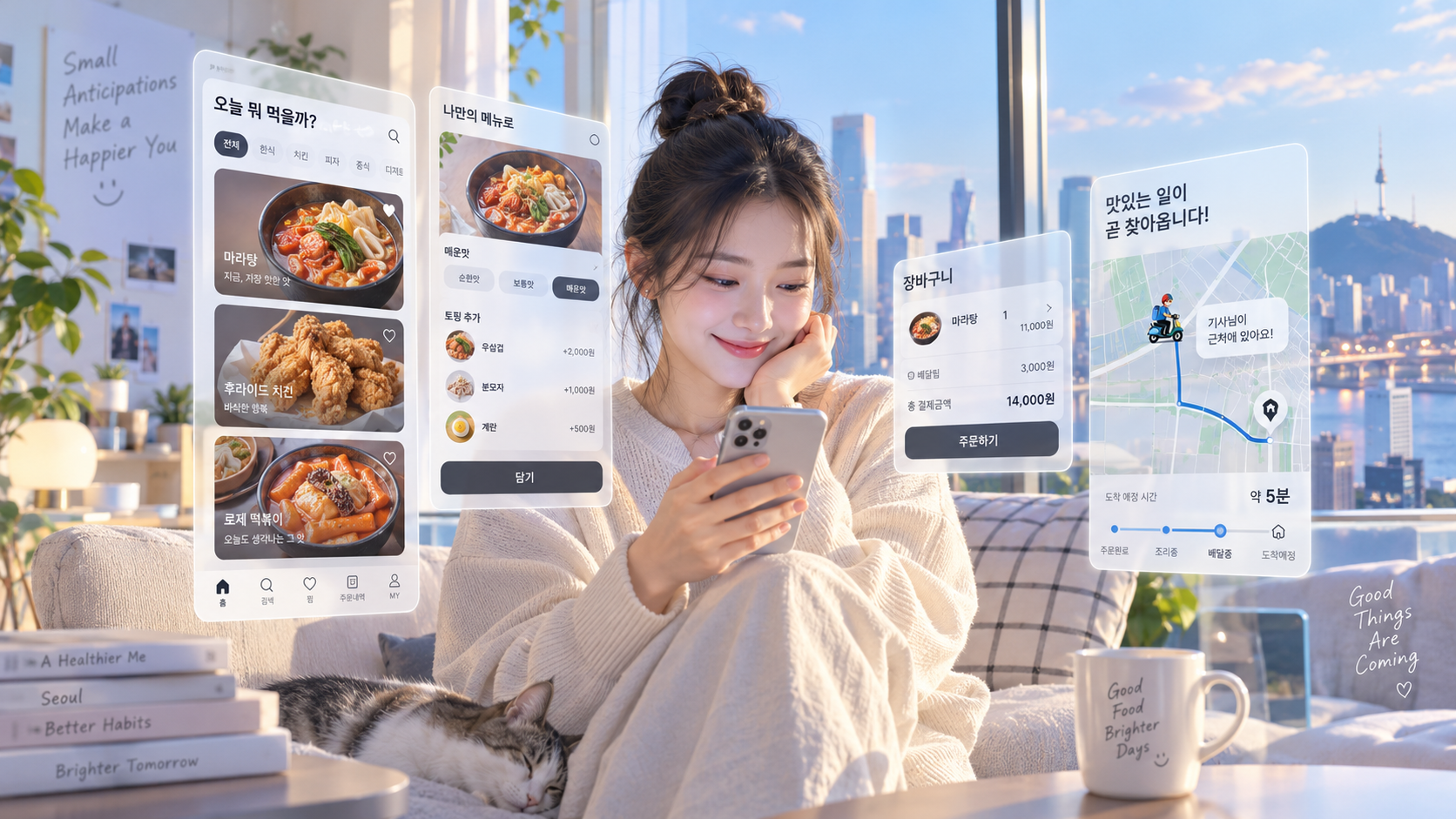
In South Korea, people are opening a food delivery app, browsing menus, filling a cart, entering an address, and watching a courier cross the map toward their door. But contrary to what you may expect, the food never arrives. There is no food because the orders are all fake. The app is called FoodNeverComes, it says so in the name, and it is part of a wave of Korean “dopamine sites” that simulate shopping with no goods, no payment, and no delivery. One of them renders a virtual cigarette that burns down on screen while strangers post anonymous messages about being tired.
It reads as absurdist comedy, and it partly is. Underneath the joke sits one of the most consistently confirmed findings in the neuroscience of motivation: the charge people chase lives in reward anticipation, the moment before the outcome, and these apps sell that moment with everything else stripped away.
The ritual is the product
Nobody using FoodNeverComes believes food is coming. The deception rate is zero. What the user gets is the full ordering ritual: the browsing, the choosing, the customizing, the button, the rider on the map. The developer, who goes by Malhee, built it after noticing his own behavior on real delivery apps, opening them out of boredom rather than hunger, and told Fast Company that “just satisfying that urge to ‘order something’ made it weirdly fulfilling.” You can run the loop, feel it complete, and walk away having consumed nothing but the loop itself. So it basically runs mainly on short-term reward anticipation, with no long-lasting reward schedule.
What reward anticipation does in the brain
Dopamine tracks the gap between what you predicted and what you got, and after learning, the response moves to the moment before the outcome. That is the finding Schultz, Dayan, and Montague published in Science in 1997: an unexpected reward produces a burst of firing, a fully predicted reward produces almost no response, and a predicted reward that fails to arrive produces a dip below baseline at the moment it was due. That third response is ordinary disappointment, measured at the neuron: the sinking feeling when something you counted on does not come. As learning proceeds, the firing shifts from the reward to the cue that predicts it, which is why the charge migrates to the click, the spin, the card about to flip. Skinner found the behavioral half of the same story with variable schedules, where unpredictable outcomes produce far more persistent behavior than reliable ones.
Read FoodNeverComes against those three states and the design turns out to be more careful than it looks. It never delivers a reward, so it cannot produce the flat response of a fully predicted one. And it cannot produce the disappointment dip either, because that dip requires a broken prediction, and this app never lets you predict food in the first place. The honesty in the name is the load-bearing wall of the design. A fake app that pretended food was coming would generate one crash per user and die. An app that promises nothing has no promise to break.
Curiosity to the max
In Octalysis terms, these apps are Core Drive 7: Unpredictability & Curiosity in near isolation, the drive that engages people through the drive to know what comes next. It sits on the right-brain, intrinsic side of the framework, and simultaneously on the Black Hat side, the family of drives that create urgency. Its similar to the engine that runs TikTok’s For You Page, where I have traced the full loop: the next swipe might be nothing, or it might be exactly your thing, and that uncertainty keeps the thumb moving.
What is unusual here is the emptiness around that one drive. Nothing in the app progresses, so Development & Accomplishment never engages. Nothing is kept, so Ownership & Possession never forms. The cart you assemble vanishes on completion, and no skill grows from assembling it.
The virtual cigarette site carries the only other signal, a thin layer of Social Influence & Relatedness in its wall of anonymous strangers, and I suspect that layer is why people linger there longer than on the shopping sites. A single drive is carrying the entire experience, and single-drive experiences have a known trajectory.
Why the pull fades
Prediction error is a learning signal, which means it is built to disappear. The brain’s whole job is to close the gap between expectation and outcome, and once the ordering ritual is fully learned, once you know every screen and every step, the open question closes and the reward anticipation that made the loop feel alive goes quiet. The first fake order is funny and strangely satisfying. The tenth is a form you have filled in before. There is no progression to reveal, no stake accumulating, no person on the other side, so nothing arrives to take over when the novelty signal fades. The wonder of these apps is how far one drive carries them. The limit is that one drive is all there is.
Craving for the win
These fake delivery apps could actually prevent the substitute for mindless scrolling and shopping. That is substitution design, the same logic as a patch for a smoker, and members of shopping-addiction communities have been debating whether it genuinely curbs compulsive spending. It could actually be true because most of the addictive reward is in the anticipation of the reward. So, fake shopping could potentially be quite rewarding for some people.
For product teams, three things transfer. The anticipation phase deserves more design attention than the reward, because that is where the charge lives, yet most teams spend their effort on the confirmation screen where dopamine has the least to do. A product must never manufacture a prediction it will not honor, because unlike these honest fakes, a product that promises and fails delivers the below-baseline dip on schedule, and users learn distrust exactly as reliably as they learn everything else. Curiosity get people in the door. What keeps them is the handoff to progression, ownership, creativity, and social connections, which is the work we do across our client engagements using the Octalysis Framework.
FoodNeverComes proved that the moment before the click can be sold on its own. Contact us if you want to find where reward anticipation lives in your own user journey, and how to optimize user journeys to it.