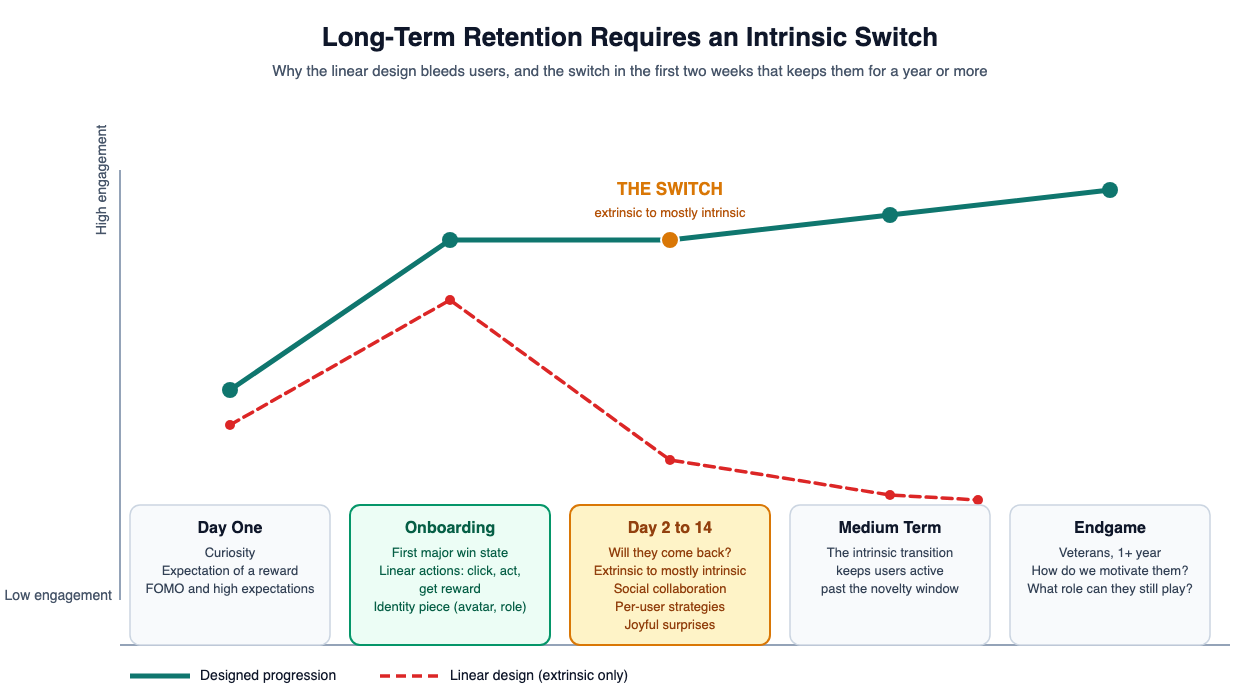
Every new experience gets a honeymoon. Curiosity brings people through the door, the expectation of a reward keeps them clicking for the first few days, and for a moment the numbers look wonderful. Then the honeymoon ends, usually around the first week, and the product faces the test it was never designed for: will these people come back when nothing new is being promised to them? Most products fail that test, and they fail it not because the features are weak, but because the motivational design was linear from the start. It walked users in a straight line from sign-up to reward, and it never planned what comes after. I have watched this pattern repeat across industries for years, and the same five moments decide every time whether an experience keeps people for a year or loses them in a month.
Day One: curiosity, the expectation of a reward, and a little FOMO
On day one, nobody is loyal. They are curious. They heard about the product, read something interesting, or watched friends use it, and curiosity brought them through the door. In the Octalysis Framework, that is Core Drive 7: Unpredictability & Curiosity, the trigger that dominates the Discovery phase. The expectation of a reward amplifies it, and for many products a touch of FOMO does the rest, the quiet fear that by staying out of this, they are missing something everyone else is already enjoying. These triggers work, which is why they are everywhere.
They also create high expectations. The user arrives excited, and the product now owes them an experience that matches that excitement. This is the first silent contract of retention, and most products default on it within a week. The trigger got the user in the door, but nothing in the design yet tells them why they should stay.
Onboarding: the first major win state
Onboarding turns the promise into a sequence of actions. The user clicks here, clicks there, completes a step, receives a reward, and maybe claims a piece of identity such as an avatar. This is supposed to feel linear, and it should. During onboarding, the user should feel smart, and the fastest way to feel smart is a string of small wins leading to the first major win state, the moment the user thinks, this is awesome.
The framework says to find that moment and count how many minutes it takes to reach it, because every second before it is a dropout risk. Yu-kai’s principle is to get users to a major win state before asking them for anything, including their identity: the win state comes first, and the identity is claimed after the user already feels powerful. Notice what the user is doing in this phase: linear actions, clear feedback, one path, no decisions to make. That is correct design. Users need a straight line before they can appreciate a maze. The sin is not the straight line. The sin is treating the straight line as the whole experience.
The switch from extrinsic to intrinsic
After a number of days, the reward has been collected a few times and the novelty of the mechanics has worn off. Now the user makes a quiet calculation: is this experience worth coming back to on its own? This is where the design must change, from purely extrinsic motivation to mostly intrinsic motivation.
Psychologists documented the reason decades ago as the overjustification effect: offer an external reward for an activity, and the intrinsic interest in the activity itself drains away. A product that keeps paying users to return is a product that must keep raising the payment, and there is no end to that treadmill.
The switch has three ingredients.
First, meaningful social collaboration. Users helping each other, working together on shared goals, feeling part of something larger than their own progress. Sustained engagement almost never comes from watching your own numbers go up in isolation. It comes from being needed, from contributing, from the moment another user thanks you for something you did.
Second, different strategies for different users. When every user is handed the same path, there are no meaningful choices, and the experience starts to feel like a routine. Give different users different ways to win, and you give them something to think about, to argue about, and to improve at. Yu-kai’s test is simple: if a hundred players all reach the win state the exact same way, the design has failed; if thirty play one way, thirty another, and forty a third, you have meaningful choices. That variety is what makes an experience worth returning to.
Third, joyful surprises. Unexpected moments, Easter eggs, mystery rewards, the small bits of unpredictability that keep the loop from becoming a habit. In the framework, these three ingredients live in Core Drive 5: Social Influence & Relatedness, Core Drive 3: Empowerment of Creativity & Feedback, and Core Drive 7: Unpredictability & Curiosity.
Most products never make this switch. The reward stays the only reason, the path stays the only path, and the user’s quiet calculation comes out the same way every time: there is nothing here for me.
Medium term: what the switch buys you
When the switch happens, the reward stops being the reason and becomes a byproduct. The user who returns in month two is not returning for the points. They are returning because they belong to a community, because they have developed mastery, and because the experience still surprises them. The challenge must also scale with their skill: an experience that demands the same effort forever eventually produces boredom, which is why the psychology of flow is built around the match between challenge and ability. Difficulty must rise as skill rises, or the player drifts out.
This Scaffolding phase is what keeps users active in the medium term: not a larger reward, but a different kind of motivation, one that grows instead of inflates. Points inflate. Mastery, belonging, and surprise compound.
Endgame: veterans and the role they can play
Finally, there are the veterans: users who have been with the experience for a year or more. They have seen the content, mastered the mechanics, and collected most of what there is to collect. For most products this is the end of the road, and the endgame is the most neglected phase of the player’s journey. The framework treats the journey as four phases: Discovery, Onboarding, Scaffolding, and Endgame. The last one is where most experiences simply stop being designed.
Veterans still have motivation, but it is different. They do not want to lose what they have built, which is why loss avoidance keeps them attached to the accounts, collections, and status they earned. And they can take on new roles. The classic endgame design is mentorship: veterans support newcomers, answer questions, and carry the culture of the experience forward. This gives the veteran a reason to stay and a role to play, and it shows new users where the journey can take them. The games that hold players for decades, chess, poker, the enduring strategy titles, are the ones that keep offering a new role long after the mechanics are mastered. That is the difference between an experience that ends and an experience that matures.
Why linear design fails
The pattern across these five moments is consistent. Linear design creates a path, users walk it, and then the path ends. It does not lead to long-term retention because it never makes the switch to increasingly intrinsic motivational design, the switch that gives people a medium-term and long-term reason to stay. And for most experiences, there is no endgame design at all. The retention curve is not a mystery. It is the shape of the motivational design, and we have spent years helping organizations reshape it; the work always starts with the same question: what should this experience mean to the user a year from now? You can see how that question plays out in real engagements on our case studies page.
If your numbers are strong in the first week and soften quietly after it, your feature set is probably fine and your motivational design is probably linear. The fix is not a bigger reward. It is a deliberate switch from the trigger that brings people in to the meaning that keeps them there. When you want to examine your own journey through that lens, Contact us and we will look at it together.