Traditional banks have spent the last decade dismantling the thing that made them dominant: their front office. Branch closures have been accelerating for years across major markets. The banker who knew your parents, who opened your first savings account, who sat across a desk from you when you applied for your first mortgage, does not exist anymore. That role has been replaced by a login screen.
Banks operated on a cradle-to-grave model for over a century. You were born into a banking relationship, often inherited from your parents, and that relationship was sustained through face-to-face interaction at a branch. The branch was where cross-selling happened. The branch was where trust was built. The branch was where the bank learned enough about your life to offer the right product at the right time. Without it, banks have lost the mechanism that carried customer relationships across decades. And they have not replaced it with anything.
The Digital Engagement Gap
Most bank websites and mobile apps are function-focused. You can check a balance, transfer funds, pay a bill, apply for a credit card. The functionality is comprehensive. But the experience is a dead end. Each task is a self-contained transaction with no reason to return until the next task arises.
This is the opposite of what banks used to have. The old branch model gave customers reasons to come back regularly: conversations with staff, relationship-building, product offers tied to your life stage. The digital equivalent has not been built by most banks. They have digitized the transactions but not the relationship. A customer who finishes paying a bill on a banking app has nothing else to do there. They close the app and do not open it again until the next bill cycle.
The result is that banks now struggle with the thing they used to do best: engaging customers across a lifetime. Without face-to-face interaction, they do not know how to cross-sell or introduce new products. Gallup’s research on workplace engagement identifies disengagement as a primary driver of lost productivity. This internal problem mirrors the external one. Employees who are disconnected from their work create customer experiences that feel transactional, and a transactional experience gives nobody a reason to return.
The Neobank Threat
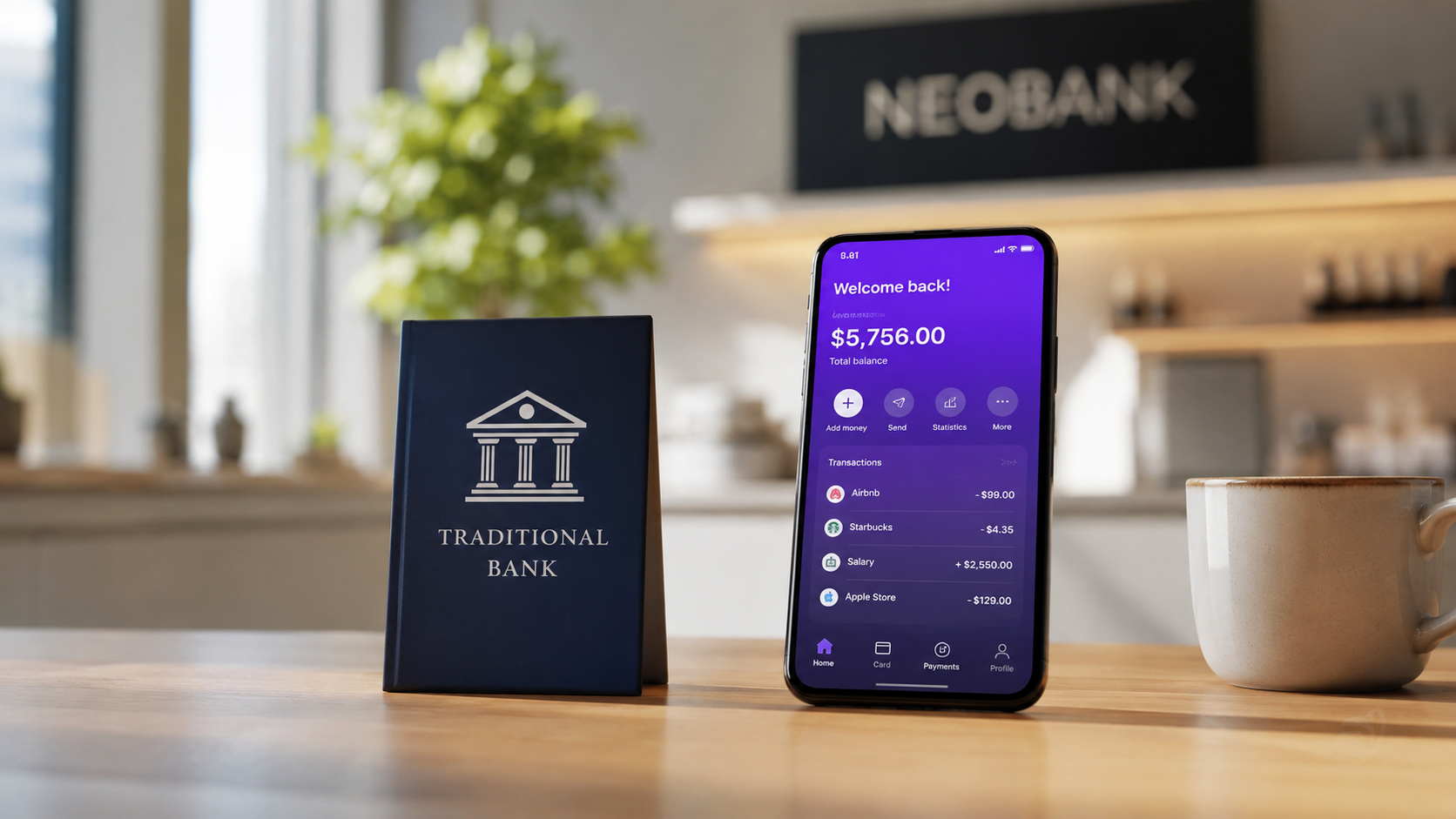
Neobanks have capitalized on this gap. Digital-only banks like N26, Monzo, Revolut, and Chime operate without branches, without legacy systems, and without the organizational drag that slows incumbents. Their cost structure lets them offer lower fees and competitive rates. Their product teams build for mobile-first experiences that feel natural to anyone under 35.
But cost and UX are not where neobanks win. They win on the journey. Neobanks design their products as daily-use experiences: spending insights that update in real time, savings goals with visual progress, instant notifications that make every transaction feel acknowledged. Each feature gives the customer a reason to open the app today, not just when a payment is due.
Engagement is a design problem. Traditional banks that try to compete on fees alone will lose, because neobanks have a structurally lower cost base. The only durable advantage incumbents have is the depth of the customer relationship. But that relationship has to be rebuilt for a digital world, and function-focused apps do not rebuild relationships.
What Banks Need to Do
The fix has two parts.
First, banks need to ensure there is a journey for people to come back to. Not a sequence of marketing push notifications about credit card offers. A behavioral journey that gives the customer something to progress toward, something to check on, something that makes opening the banking app feel purposeful even when there is no immediate transaction to complete. The cradle-to-grave model did this in physical form. Every visit to the branch was a step in an ongoing relationship. The digital version requires intentional behavioral design that gives the customer a sense of forward motion.
Second, banks need to make sure there is always something to do in the experience. A banking app that only offers transactions is a tool you pick up when needed and put down when done. When the experience includes goals to track, milestones to reach, adaptive content that responds to your financial situation, the customer has a reason to return even on a day with no payments due. This is the difference between a utility and a destination.
What This Looks Like in Practice
Chase ran a program called “Chase Picks Up the Tab” that gave cardholders surprise rewards on everyday purchases. The mechanic was simple: every 500th debit card purchase was refunded. Customers started checking their rewards because the possibility of a surprise turned a routine purchase into something worth paying attention to. That is behavioral design working with almost no budget. The mechanic was simple. The effect on engagement was outsized because it created ownership: the customer felt that using the Chase card was different from using any other card, not because of the interest rate, but because of what might happen when they did.
Truist Financial took a different route to the same destination in 2022 when it acquired Long Game, a fintech startup that turned savings behavior into a gamified experience for younger users. A top-ten US bank buying a gamified savings app was not a gimmick. It was a signal that sustained engagement with financial behavior requires motivational design, not just a clean interface. Truist recognized that the neobank threat is not about who has the best app. It is about who has the experience that customers choose to return to.
When we worked with DBS Bank, the objective was to build a behavioral architecture that sustained engagement across the entire customer relationship, not a one-off campaign. The design embedded motivational triggers into existing banking interactions so that customers felt a consistent pull to progress financially. Engagement increased because the experience had a journey built into it. Customers were not asked to play a game. They were given a banking experience that felt worth coming back to.
At Caixa Economica Federal, a Brazilian bank founded in 1861 with 4,500 branches, the challenge was internal. The starting baseline was 10% participation in workplace initiatives. Decades of incentive programs had produced fatigue, not motivation. We built a cooperative design where employees worked toward shared outcomes and collective achievements rather than competing for individual rewards. Participation moved from 10 percent to over 90, and that shift carried directly into customer-facing performance. When employees feel that their daily work connects to something larger than their individual targets, the customer experience changes. Engaged employees create the kind of environment that makes customers want to stay.
The Market Is Already Moving
The gamification market is projected to grow from $20.84 billion in 2025 to over $190 billion by 2034. Banking will capture a meaningful share of that investment because banking has the most to lose from inaction. Neobanks are not slowing down. Customer expectations, shaped by every other digital product they use daily, are not lowering. The banks that treat engagement design as a core capability will hold their customer base through the transition. Those that continue digitizing transactions without building a reason to return will become invisible utilities, competing on rate alone, losing the relationship they spent a century building.
The work starts with two questions. Does your experience give customers a reason to come back tomorrow? And when they arrive, is there something to do? If your team cannot answer both with confidence,contact us.