How Booking.com Turned Urgency Into Profit: A Behavioral Design Deep Dive
 Joris Beerda15 June 2026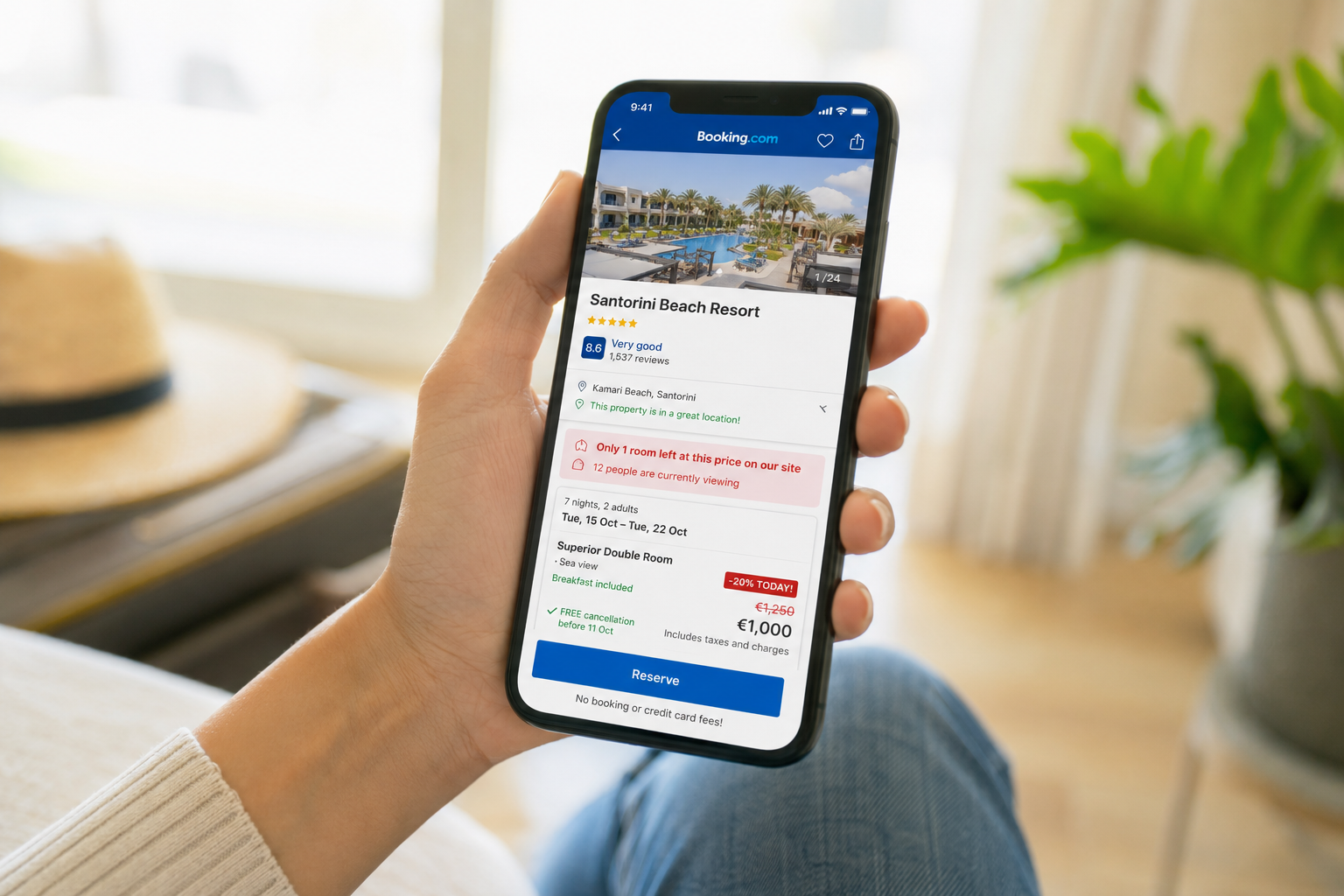
The travel booking market punishes hesitation. A visitor can compare prices on multiple platforms in minutes, switch tabs without friction, and disappear from your funnel after a single search. Capturing that visit is easy compared to the real challenge: converting an uncertain browser into a committed buyer before they close the window.
When I first studied Booking.com’s funnel, I did not see a clever “gamification layer.” I saw a high-intent, low-frequency decision compressed into one fragile moment: the night you decide to book, you either complete the reservation or you leave and forget. The entire behavioral design question becomes: how do you compress consideration, commitment, and justification into a single session without making the experience feel like a casino?
That is the lens I used when Booking.com engaged The Octalysis Group in 2015. The goal was to increase the probability that a user who had already found a relevant property would pull the trigger during that visit, and to do it in a way that could scale across millions of room nights and hundreds of markets.
The Real Problem: High Intent, Low Commitment
Most travel shoppers arrive with a surprisingly clear mental picture: approximate dates, a city, a rough budget, and at least one non-negotiable constraint such as free cancellation or proximity to a landmark. They are not casual window-shoppers; they are standing on the edge of a decision cliff.
Before 2015, Booking.com already surfaced reasonable nudges: “Recommended for you” rankings and “X people are looking at this hotel” indicators tapped into Social Influence & Relatedness in a mild way. Visitors scrolled, compared, and felt increasingly confident that they had options. The site succeeded at building interest, but the design stopped just shy of the one behavior that mattered most: committing to a booking in that session.
I see this pattern across many transactional products. Teams polish catalog pages and search results, celebrate engagement metrics, and only later notice that the shape of their funnel rewards browsing rather than deciding. The Booking.com pre-2015 flow had this exact gap: users felt safe to look around because nothing in the design translated “I like this” into “I should book this now.”
Why This Context Can Sustain Heavy Black Hat
When I evaluate a product with the Octalysis Framework, I start from the cadence of the core decision, not from a list of mechanics. A daily learning app, a long-term health program, and a once-per-year travel booking should never share the same motivational mix, even if they all use discounts and progress bars on the surface.
Booking.com’s key decision is episodic and high stakes: you might book two or three trips a year, and each booking session can involve hundreds or thousands of dollars. That pattern supports much heavier Black Hat pressure than a recurring experience. The user is willing to endure tension for a few minutes in exchange for the relief of securing a good deal, and you do not need to protect long-term enjoyment in the same way you would for a product that lives in someone’s daily routine.
This is where Scarcity & Impatience, Unpredictability & Curiosity, and Loss & Avoidance become legitimate tools rather than landmines. If your team leans on them in a daily habit context, you burn trust and trigger churn. If you use them in a one-shot purchase, you can compress indecision into action as long as the value proposition remains credible and the user feels they are beating the market instead of being exploited.
Designing for Scarcity, Social Proof, and Status
When I dissected Booking.com’s redesign, I did not treat the urgency layer as a collection of random labels. I treated each message as a behavioral commitment device tied to a specific Core Drive and a specific moment in the journey from search to payment.
1. Scarcity & Impatience in the moment of choice. Messages like “Only 1 room left on our site,” “In high demand,” and “Booked 60 times in the last 24 hours” sit exactly where the user is considering an individual property. These cues weaponize Loss & Avoidance by turning abstract risk (“maybe prices go up later”) into concrete risk (“this particular room may disappear if you close the tab”). They also draw on the scarcity principle documented in hospitality research: when availability appears limited, perceived value and willingness to act increase, especially at shorter booking lead times [web:1].
2. Social proof as validation, not decoration. Real-time indicators such as “12 people are looking at this property right now” and dense review aggregates provide Social Influence & Relatedness in a specific way: they answer the question, “If I commit now, am I making a foolish choice?” Cornell Hospitality Research has shown that stronger online reputation and review volume correlate directly with higher Revenue Per Available Room, confirming that social proof in travel drives revenue directly [web:2].
3. Status and instant rewards through Genius. The Genius program does something most loyalty layers fail to do: it makes status immediately useful at the point of decision. A visible “Genius” label plus an instant 10% discount reframes the purchase from “I am just booking a room” to “I am using a benefit I earned.” This taps into Ownership & Possession and a mild sense of accomplishment; users feel they would waste their privileged access if they walked away. The psychological move is subtle but powerful: the discount becomes a justification to act on the urgency signal rather than a generic promotion floating in the background.
When your team treats these three layers as a single behavioral composition, the pattern is clear. Scarcity creates pressure, social proof reduces fear of a bad decision, and status provides a socially acceptable story the user can tell themselves about why they booked now and not later.
The Financial Trajectory After the Shift
Because I care about causality, I never attribute company-level growth to a single design project. What I can do is show how Booking.com’s financial trajectory changed in the period when behavioral design, experimentation culture, and aggressive expansion worked together.
According to Booking Holdings’ annual reports, gross profit in 2015 was approximately 8.6 billion dollars, with revenue at 9.2 billion dollars and near-100% gross margins in the agency model [web:3]. By 2019, reported revenue had reached 15.1 billion dollars, which implies a similar level for gross profit and represents roughly 75% growth over four years on a large base [web:3].
Room nights booked increased from 477.5 million in 2015 to 557.4 million in 2016 (a 16.7% year-over-year increase) and 673.6 million in 2017 (up 20.9% year-over-year) [web:3]. Over the same period, total gross bookings rose from 51.5 billion dollars in 2015 to 68.7 billion dollars in 2016 (up 33.4%) and 81.2 billion dollars in 2017 (up 18.2%) [web:3].
I treat these numbers as evidence that Booking.com successfully converted its experimentation and behavioral design investments into measurable throughput: more room nights, larger booking volume, and higher effective monetization of existing traffic. Behavioral design did not create travel demand out of thin air; it changed what happened after users landed on the site, and that effect compounded over time.
The Experimentation Engine Behind the Interface
What impressed me most about Booking.com was the operational system that allowed such banners to evolve. A static urgency design would have decayed as users habituated. A live experimentation engine guaranteed that even small behavioral ideas could be tested, tuned, and killed quickly.
A Harvard Business School case by Stefan Thomke and Daniela Beyersdorfer documented that Booking.com ran around 1,000 concurrent A/B tests across 75 countries and 43 languages, with the ability to deploy a new experiment in under an hour [web:4]. An external analysis by VWO highlighted the same pattern: experimentation was a default way of operating product decisions [web:5].
Lukas Vermeer, Booking.com’s former director of experimentation, described in an academic paper how the company built a self-service experimentation platform so that diverse teams could run online controlled experiments without relying on a central bottleneck [web:6]. In his Mind the Product keynote, he emphasized cultural norms such as challenging HIPPO decisions (Highest Paid Person’s Opinion) and treating every change as a hypothesis that needed data to survive [web:7].
From a behavioral design perspective, this matters because urgency copy, scarcity thresholds, and Genius triggers are not “set and forget” features. They are ongoing experiments where your team needs evidence on where pressure starts to harm trust, where discounts stop moving the needle, and where social proof saturates. Booking.com’s willingness to test aggressively is part of why their Black Hat-heavy design works at scale without collapsing user goodwill.
Why This Playbook Fails in Loyalty and Habits
Whenever your team sees a high-performing example of Black Hat design, there is a temptation to transplant it into every funnel. In my experience, this is where behavioral design goes from surgical to reckless. The Booking.com pattern only works because the core decision is episodic and high-intent; loyalty and habit experiences do not share that profile.
In a loyalty program, users face a long horizon of repeated interactions: checking point balance, choosing redemptions, and evaluating whether engagement still feels worthwhile. If your team layers on heavy scarcity, loss-framed messaging, and constant pressure, members interpret every interaction as a risk rather than an opportunity. The result is high signup and high inactivity, a pattern many airline and retail loyalty programs have documented through low active-member percentages and low redemption rates.
I have seen loyalty teams obsess over extrinsic rewards: points, tiers, and expiring offers, while leaving users with little sense of progress, autonomy, or meaningful contribution. They are competing purely on Black Hat and extrinsic motivation in a context that demands White Hat and intrinsic meaning. The more they copy Booking.com’s “only X left” language into a multi-year relationship, the more members quietly decide that the mental load of participation exceeds the benefits.
The design rule I apply is simple: if the same user decision recurs weekly or daily, your team must shift weight toward White Hat motivation. If the decision recurs a few times per year with high stakes and planning, you can afford more Black Hat in the short window where the decision is live, as long as the underlying value proposition remains strong.
How I Now Diagnose Transactional Products
The Booking.com case changed how I enter any new engagement. I do not start by asking which badges, points, or levels a product should use. I start by mapping the core decisions, their frequency, and the emotional states on either side of those decisions.
For one-shot or rare transactions (large purchases, travel, one-off events), I expect to lean harder on Scarcity & Impatience and Loss & Avoidance at the exact moment of choice, supported by strong social proof. For ongoing relationships (subscriptions, communities, learning platforms, health apps), I expect to lean harder on meaning, progress, and creativity, and to treat Black Hat as a salt-like accent used sparingly around deadlines or special events.
If your team cannot clearly articulate which Core Drive a mechanic targets, which player type it serves, and which Experience Phase it belongs to, you are not doing behavioral design; you are adding noise. Booking.com’s urgency layer looks simple, but when you audit it through that lens, every key message has a job, a target emotion, and a place in the journey.
What I Look At When I See Your Funnel
When I review a product today, I run an informal version of the same exercise I used for Booking.com. I look at how often the key behavior recurs, whether the current design rewards browsing or deciding, and where your team has accidentally inverted the motivational mix, using long-term Black Hat where White Hat is needed, or vice versa.
I also check whether your experimentation practices match the risk of your behavioral choices. Heavy urgency without robust A/B testing is a liability. Light-touch motivation with no feedback loops is a missed opportunity. The Booking.com story is a reminder that behavioral design and experimentation are inseparable when real revenue is at stake.
If you are wondering whether your product behaves more like Booking.com’s one-shot decision or a loyalty journey that lives for years, that is the first question worth answering before you touch any UI element. The rest of your behavioral choices cascade from that single diagnosis.