Think about the last time you opened your banking app. You probably had something specific to do. Check a balance, pay a bill, move some money. You did it, the task was finished, and you closed the app until the next bill came around. Nothing was wrong with the app. That is exactly the problem for a bank that wants customers to engage. That is where gamification for banking starts. If I open your app today and nothing is due, what is there for me to do?
The numbers show a version of this. In the first half of 2024, UK neobanks gained about 9.5 million new Android users. That is 81% more than the roughly 4 million that traditional UK banks added, according to SplitMetrics. A study in Brazil by RankMyApp, covering April 2024 to April 2025, found the opposite in daily use. Traditional banks lead on daily active users, monthly active users and stickiness. Fintechs and digital wallets win installs with cashback and coupons, then struggle to keep people.
Both studies have limits. SplitMetrics counts new Android users and says nothing about how often they open the app. RankMyApp’s sample comes from its own database. Still, I would read them together as a warning. Installs can be bought, and daily use needs a reason to open the app when nothing is due. In this article I show how we approach that with the Octalysis Framework, with examples from our DBS work and the program for Brazil’s Caixa Econômica Federal.
Why Gamification for Banking Starts With a Reason to Open the App
Product teams usually aim for intuitive and efficient. That is fine if the user is already motivated, but as we wrote in six mistakes of products that fail to engage users, they usually are not. Efficiency alone does not give people a reason to return. Checking your balance is the exception, because you need the number and will put up with a clumsy app to get it. Nobody feels a pull to open a banking app on a Tuesday afternoon with no bill to pay.
The usual answer is an incentive. Cashback, a coupon or a sign-up bonus will win the download. The RankMyApp study suggests it rarely wins the second month. Those incentives are extrinsic, so if the reward disappears, people stop. The question I like to ask is what the app can offer that people would still want without the reward.
Truist and Long Game
In 2022, Truist acquired Long Game. The 12-person startup had built a gamified finance app around prize-linked savings and casual games. Long Game’s CEO described the product as using game dynamics to drive financial literacy, with a trivia element and rewards for learning. A Truist executive said the bank wanted to deepen customer relationships and attract younger customers with a gamified way to save.
Through the Octalysis lens, prize-linked savings is mostly Core Drive 7: Unpredictability & Curiosity. You save, and there is a chance to win something. The trivia lets you see yourself learning. Long Game’s engineers, designers and executives also joined Truist’s innovation team, so the bank bought people who understand motivation, and not only an app. I think a bank that spends money on that has noticed the same gap.
DBS: Gamification for Banking Across Six Projects
DBS is the largest bank in Singapore. New mobile fintech banks pushed in with lower costs and lower prices. DBS wanted a customer experience that was more engaging than the one the newcomers offered. We worked on six projects together, ranging from credit card program design to loan applications and SME programs.
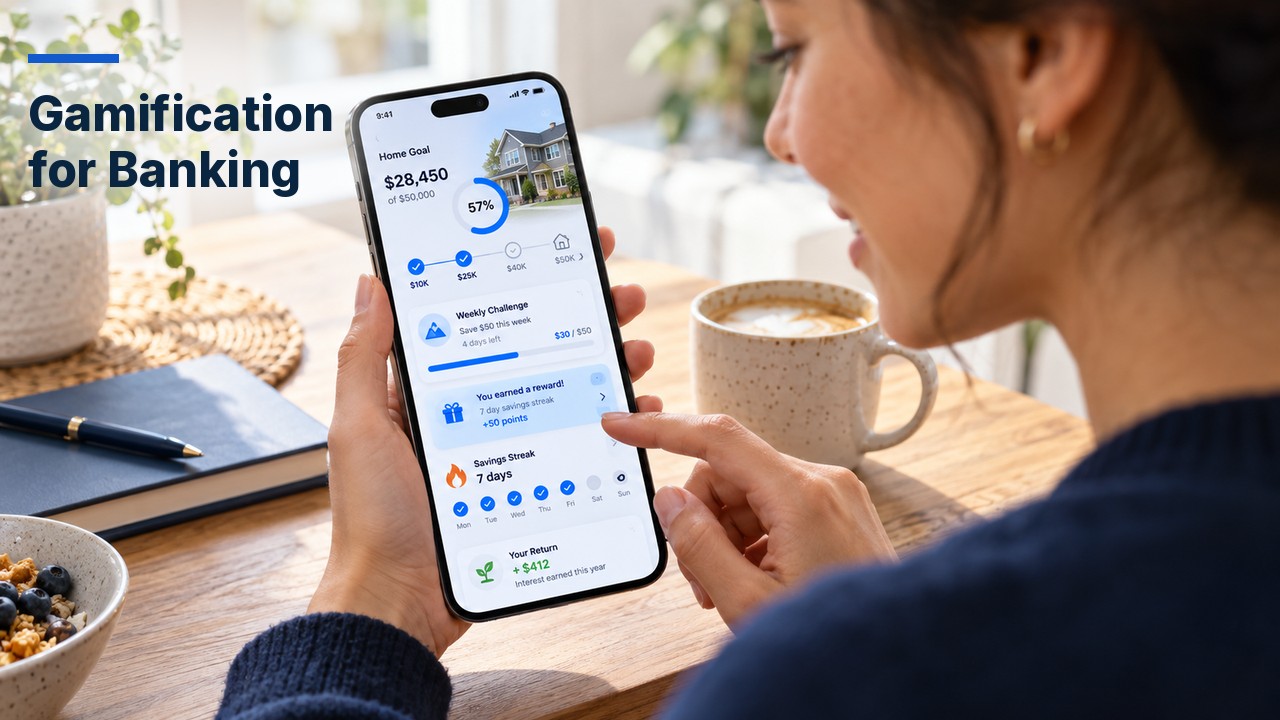
The idea was that every customer could follow a path of their own. Personalized financial goal-setting tools adapted to individual spending habits and savings targets. That is Core Drive 3: Empowerment of Creativity & Feedback, because customers make choices and see the result. We added daily surprises, such as random reward drops. We also added personalized challenges and leaderboards, so customers could compete with friends or against their own benchmarks.
According to the DBS case study, one year in and with 30% of the design implemented, credit card spend rose 30%, loan approvals 20%, savings account openings 15% and DBS PayLah app transactions 24%. Only 30% of the design was live when someone measured those numbers, which is why I find them interesting.
They are customer-facing results, so they are the closest match to the problem this article started with.
Caixa Econômica Federal: The Same Gap Inside the Bank
This is a different kind of case, and I want to be clear about that. It was a program for the bank’s own employees and not for its customers. Caixa Econômica Federal, the Brazilian public bank known as CAIXA, has more than 85,000 employees in about 4,500 branches. It is not CaixaBank. Participation in its sales initiatives was around 10%. Staff ignored the KPI emails and cash bonuses.
We designed a cooperative program called Tamo Junto 9Bi+, Portuguese for “Together We Reach 9 Billion+”. Employees collected puzzle pieces for hitting small targets and traded them with colleagues to complete sets. Collecting puzzle pieces is Core Drive 4: Ownership & Possession. Trading brought colleagues into a job that had been solitary. The rewards were both instant and aspirational. Everything centered on a shared goal for the bank.
In the Caixa Econômica Federal case study, participation goes from about 10% to 92.61%, with 77,000 active users and 7 million platform visits. It reports a 49% increase in net income, about $1 billion. The program reached four departments in three months.
The link to customers is indirect, and I will not claim more than that. Walk into a branch where staff care about a shared goal, and it feels different. It also shows that the same thinking applies inside a bank and outside it.
The Four Phases of Gamification for Banking
When we design for a bank, we follow the customer through the four Experience Phases that my co-founder Yu-kai Chou defined. Motivation and skill differ a lot between the first use and the 50th or 100th. Our working definition of gamification is that people continuously come back to an experience, in the short, medium and long term, because the design is balanced across the eight Core Drives and evolves with their seniority over time. Each phase needs its own design.
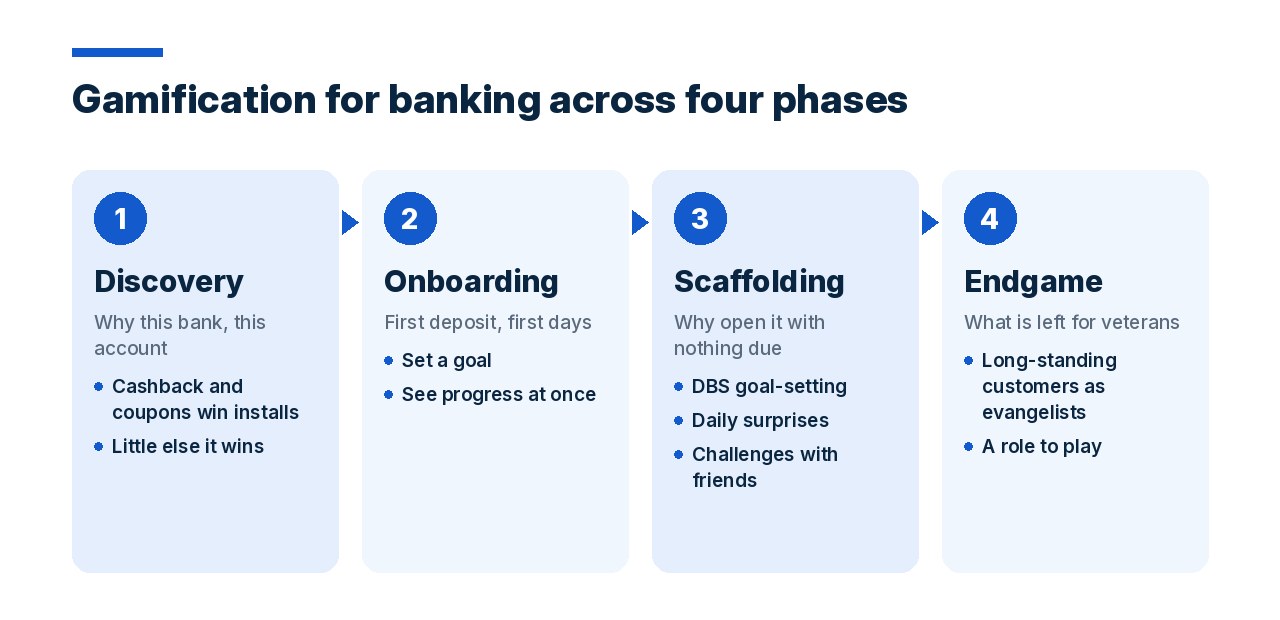
Discovery is why a person considers this bank or this account at all. In gamification for banking, cashback and coupons are the common answer. As we saw, they win downloads and little else.
Onboarding covers the first deposit and the first days. In a bank it is often pure admin: forms, ID checks and passwords, before the customer has felt anything. The first win has to come right after that. It should be simple: do this, do that, wow, you did it, do it again. Setting a goal and seeing progress toward it works better than a long tutorial. Most of the design out there stops here.
Scaffolding and Endgame in Banking
Scaffolding is the regular use. A banking app usually fails here, because the tasks are closed and nothing pulls the customer back between them. Customers slowly become senior users, and this is where we start adding more intrinsic design elements. The DBS goal-setting, daily surprises and challenges all sit in this phase. Scaffolding is also where a login turns into a habit. We cover that in why simple reward systems fail at long-term habit formation.
Endgame is for long-standing customers who have tried everything the app offers. The question is what they can still do. Yu-kai calls these veterans your best evangelists. With a role such as maven, they can help onboard new customers, invite their friends and become brand ambassadors. Late Scaffolding and Endgame should lean mostly on intrinsic, White Hat design. They are the phases that usually go undesigned.
Handling Pressure in a Financial Product
Customers hand a bank their money, so I am careful with pressure. Yu-kai groups the Core Drives into White Hat and Black Hat. White Hat drives, Core Drives 1, 2 and 3, make people feel good about what they are doing: meaning, accomplishment and creativity. Black Hat drives, Core Drives 6, 7 and 8, are scarcity, unpredictability and fear of loss. They create urgency, and people do not necessarily feel good about them. Core Drives 4 and 5, ownership and social influence, can go either way.
I am not against Black Hat design. It is a tool, and it works best in proportion. A limited offer now and then is fine, as long as you never carry out the threat behind it. Taking away what a customer has earned makes them feel out of control, and they leave. A product that keeps customers anxious about their money wears down trust, and trust is what a bank sells.
I also like to bring compliance in early. A reward that looks harmless in a design review can read differently once a regulator or a customer sees it next to a loan or an investment product. If the rules are known on day one, the design can work with them instead of being rebuilt at the end. Goals, progress and surprise tend to be a safer place to start. We cover how the pieces fit together in what good app gamification looks like. Our older articles on gamification in mobile banking and gamification in financial services cover the earlier thinking.
Where a Banking Project Starts
A gamification for banking project usually starts small. We start with one customer segment and one business metric. Savings balances or the number of products a customer holds are typical examples. The metric has to be sharp. Active users is too vague, while weekly active users who complete a savings action is something you can measure. Our Strategy Dashboard guide shows how we refine it, and any success numbers should relate back to it.
Then we write down the Desired Actions that move that metric, including the small steps such as logging in, completing a profile or setting a first goal. No step is too trivial, because each one is a place where people drop off. A screen should have one dominant action. Next we sort the actual customers into four player types with a 2×2 of two mutually exclusive characteristics. For a bank these could be digitally confident or not, and focused on efficiency or on enjoying the experience. Each type gets its own path through the four phases. The Octalysis Framework gives product, marketing and compliance teams a shared vocabulary for that conversation.
If your app handles transactions well and customers still vanish between them, the TOG case studies show how we approached it for other banks. I am happy to discuss further, so feel free to contact us.