Intrinsic vs. Extrinsic Motivation in Loyalty Program Gamification
 Joris Beerda1 March 2022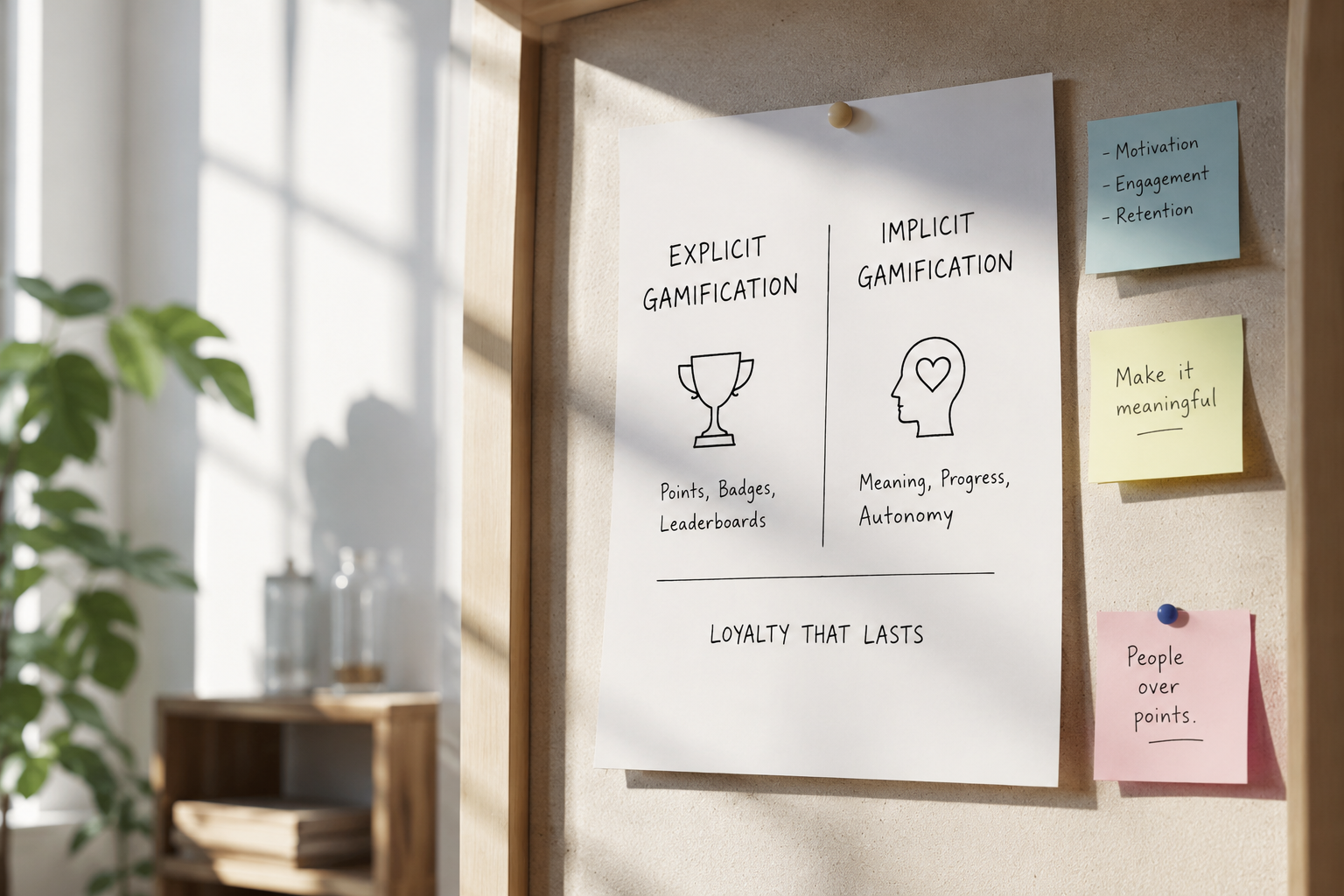
The biggest mistake in loyalty program gamification is not weak mechanics. It is a broken motivational mix. Teams keep shipping points, tiers, badges, and seasonal campaigns that look like games but function like discount machines. The launch month looks strong. Then engagement flattens. Then the business starts buying activity with richer rewards, and margins begin to bleed.
After years of applying the Octalysis Framework across airline loyalty, financial services, gaming, and healthcare, the pattern is usually the same. The mechanics are not the issue. The program is overbuilt on extrinsic motivation and underbuilt on intrinsic motivation.
This distinction is the most important concept in loyalty program design, and it is the one most teams skip. If you understand the difference clearly, you can diagnose why a program spikes early, plateaus fast, and becomes dependent on promotions. If you ignore it, you will keep treating loyalty like a pricing problem instead of a behavioral design problem.
What extrinsic and intrinsic motivation actually mean
Self-determination theory, developed by Edward Deci and Richard Ryan, draws a clean line between two kinds of motivation. Extrinsic motivation is driven by separable outcomes. People act to receive something outside the activity itself, such as points, discounts, cashback, prizes, perks, or status labels. Intrinsic motivation is different. People act because the experience itself feels rewarding, whether through curiosity, mastery, social connection, identity, or meaning.
In loyalty, that distinction changes how a program behaves. Extrinsic gamification gives members something for doing something. Spend more, earn more. Hit a threshold, unlock a perk. Complete a challenge, get a bonus. These mechanics matter, and every serious program needs them. But a loyalty program built only on extrinsic mechanics teaches members to calculate value constantly. Once that happens, the relationship becomes fragile. A member who calculates will leave as soon as someone else offers a better deal.
Intrinsic gamification does something different. It makes the experience itself worth returning to. A member checks in because something new may be happening. They participate because the progression feels satisfying. They stay because the experience has become part of how they interact with the brand. Nobody has to pay them for every action because the activity itself carries emotional value.
Why extrinsic-only loyalty programs decay
The Octalysis Framework maps eight Core Drives of human motivation. Some of these drives create uplifting, long-term engagement. Others create urgency, tension, or fear of missing out. Both categories can be useful. The mistake is relying on too few of them.
Most loyalty programs lean almost entirely on Development and Accomplishment, Ownership and Possession, and sometimes Loss and Avoidance. In practical terms, that means members earn points, level up, protect balances, and respond to expiration pressure. Those are real mechanics, but they do not create much emotional depth by themselves. They create compliance, not attachment.
That is why the engagement pattern is so predictable. Month one rises on sign-up bonuses and launch incentives. By month three, the novelty wears off and the value gap between actions and rewards starts to feel larger. The team responds with another campaign, another multiplier, another temporary bonus. The lift appears, then fades again. The problem is not that the promotions fail. The problem is that the program has no gravitational pull of its own.
A loyalty program that depends entirely on extrinsic rewards behaves like a vending machine. Insert behavior, receive benefit, move on. Vending machines create transactions. They do not create loyalty.
This is exactly why Harvard Business Review argued that many loyalty programs fail to build emotional connection and end up training customers to shop on price. When loyalty is reduced to a math equation, customers become more price-sensitive, not less.
What LATAM Airlines proved
The LATAM Airlines case study is useful because it shows what happens when a loyalty program keeps its extrinsic structure but adds an intrinsic layer. LATAM Pass began as a familiar earn-and-burn miles program. Members accumulated miles, redeemed them for flights, and most engagement was concentrated among a relatively small group of frequent travelers. A large share of the base remained passive.
The redesign, called Treasure of Dreams, reframed the experience around narrative, discovery, and participation. Instead of simply checking balances and waiting for the next transactional reward, members explored a treasure-map experience, completed missions tied to business goals, and encountered variable rewards that created anticipation around what might come next.
This mattered because it activated motivational drives that the old design barely touched. Unpredictability and Curiosity made the experience feel alive instead of fixed. Empowerment of Creativity and Feedback gave members more agency in how they progressed. Social Influence and Relatedness increased the visibility and normality of high-engagement behavior inside the experience.
The reported results were strong. The campaign increased mileage accumulation by 123 percent, lifted credit card acquisition by 153 percent, and drove a 1,407 percent increase in alternative mileage redemption. It also generated more than 160,000 unique visits, average session duration of 3.5 minutes, and over 8 million interactions in a single month, according to the published case study.
The lesson is balance, not replacement
The point is not that points, tiers, and rewards are bad. They are necessary. Members need to understand what they earn, how they progress, and what the program gives back. A loyalty system without an extrinsic backbone usually feels vague and commercially weak.
The real lesson is that extrinsic mechanics alone cannot produce durable engagement. They generate action as long as the visible reward feels close enough and attractive enough. But the moment a competitor matches the value, shortens the path, or removes friction, the relationship becomes replaceable.
Intrinsic mechanics protect against that commoditization. A meaningful community is difficult to copy. A narrative system that members care about is difficult to clone. A feeling of competence, identity, and emotional investment is much harder to outbid than a bonus rate or discount percentage. That is where durable loyalty starts to emerge.
How to audit a loyalty program properly
If you want to diagnose whether your loyalty program is flattening because of motivational imbalance, map every major mechanic against the eight Core Drives in the Octalysis Framework. Include onboarding, point accrual, tiers, challenges, rewards, content, community touchpoints, notifications, redemption, and retention campaigns.
If your mechanics cluster tightly into only two or three drives, especially extrinsic ones, you have likely found the cause of the decay before the data fully exposes it. Stronger long-term programs usually distribute engagement across a broader set of drives and include at least a few mechanics that are intrinsically rewarding even when no immediate economic incentive is visible.
Why most teams still get stuck
Most product teams do not ignore intrinsic motivation because they disagree with it. They ignore it because extrinsic design is easier to spec, easier to measure, and easier to justify. Awarding 500 points per 100 dollars spent fits neatly into a forecast. Designing for curiosity, social identity, and meaningful agency requires behavioral methodology, not just campaign planning.
That is why so many loyalty programs look busy but feel hollow. They are full of mechanics and empty of motivation. They have dashboards, tier ladders, reward catalogs, and promotional calendars, but they do not give members a compelling reason to care when no one is handing out a bonus.
The programs that survive the hype cycle are the ones that get the intrinsic layer right. The ones that do not keep returning to the same fix: more promotions, more discounts, more points, and more margin pressure to temporarily hide a curve that keeps flattening.
Contact us for a chat on how we can help create true lasting loyalty in your products and programs.